Driverless Robotaxis Go Commercial in Abu Dhabi
Core Data/Events
In January 2026, Baidu’s “Apollo Go” and UAE’s AutoGo launched fully driverless Robotaxi commercial operations open to the public on Yas Island, Abu Dhabi. This marks the first time a Chinese autonomous driving company has achieved the critical trinity of “public-facing, fully driverless, and commercialized” services overseas.
Leading Chinese and US companies have reached an order scale of tens of millions. Baidu Apollo Go has accumulated over 17 million orders; Waymo completed over 14 million trips in 2025 alone. The competitive focus has shifted from “roadworthiness” to “scalable operations and cost control.”
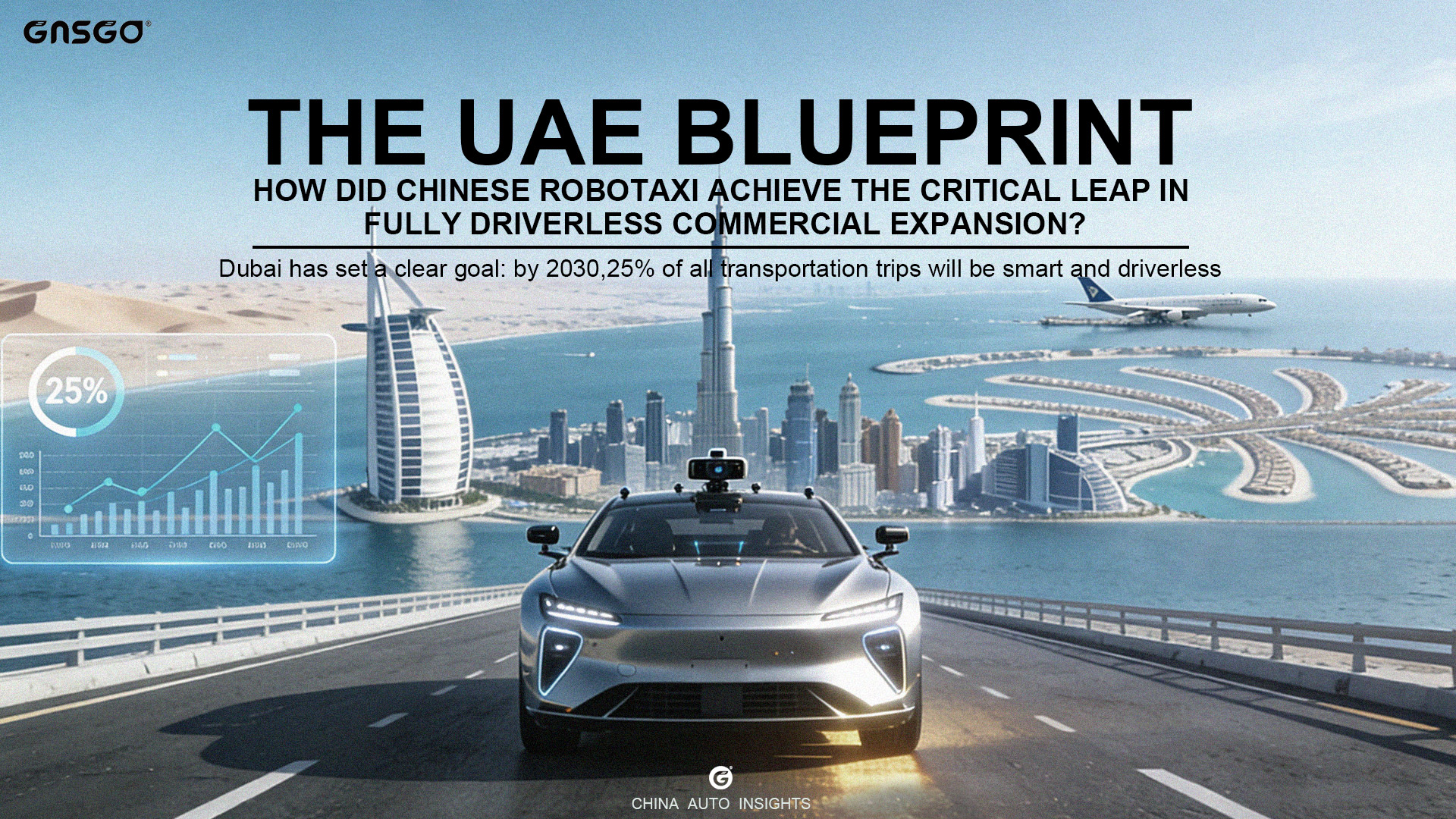
The UAE has elevated autonomous driving to an urban strategy. Dubai has set a clear goal: by 2030, 25% of all transportation trips will be smart and driverless, providing the industry with definitive policy expectations.
In-Depth Analysis From “Technology Export” to “System Export”: Why Has the UAE Become a Global Template Market?
The UAE’s success is not accidental; it provides a replicable “Regulation-Market-Operation Golden Triangle” model for Chinese Robotaxi globalization.
Top-Down Design Driven: Cities like Dubai and Abu Dhabi have set clear quantifiable urban KPIs (e.g., 25% automation rate), transforming Robotaxi from a “tech demo” into an essential “governance tool,” significantly reducing policy uncertainty.
Efficient and Executable Regulatory Framework: UAE regulators (e.g., Abu Dhabi’s ITC) grant licenses directly to consortiums of “tech provider + platform + local operator” (e.g., Baidu+AutoGo, WeRide+Uber), clarifying operating entities and liability boundaries, and closing the loop from principle approval to operational oversight.
Dual Adaptation to Scenario and Society: Tourist islands (e.g., Yas Island) offer ideal ODDs with simple road structures and stable demand. Meanwhile, the local mobility service industry’s heavy reliance on expatriate labor and supply shortages make autonomous driving a practical solution for supplementing capacity and improving efficiency, not merely a technological replacement.
Industry Insights
A Clear “Urban Value Proposition” is the Master Key to Overseas Markets. When expanding globally, explaining to local governments how to solve their actual pain points (e.g., labor shortages, tourist area capacity, smart city image) is more effective for securing resources than emphasizing technological “leadership.” The UAE case proves that integrating technology into the urban governance blueprint is the most efficient landing strategy.
Robotaxi Commercialization is Essentially an “Operational Science,” Where Local Allies are Crucial. Successful overseas projects are invariably hybrids of “technology + operations.” The role of Chinese companies is shifting from vehicle manufacturers to core system suppliers and operational enablers. Selecting and empowering strong local partners to jointly handle maintenance, compliance, and user service is the only way to avoid operational misfires and achieve rapid scaling.
The “Rapid Iteration” Capability of China’s Supply Chain Could Become a Hidden Advantage in Global Competition. Facing hardware challenges posed by the Gulf’s unique environment (e.g., sensor cleaning, heat dissipation), Chinese companies, leveraging the agile engineering and supply chain responsiveness honed in the vast domestic market, may develop a unique iterative efficiency advantage in adaptation and cost control compared to international rivals.
Robotaxi AutonomousDriving GlobalExpansion UAE BaiduApollo Driverless SmartCity AutoTech