Hong Kong: Chinese Brands Pass 35% Market Share
Core Data/Events
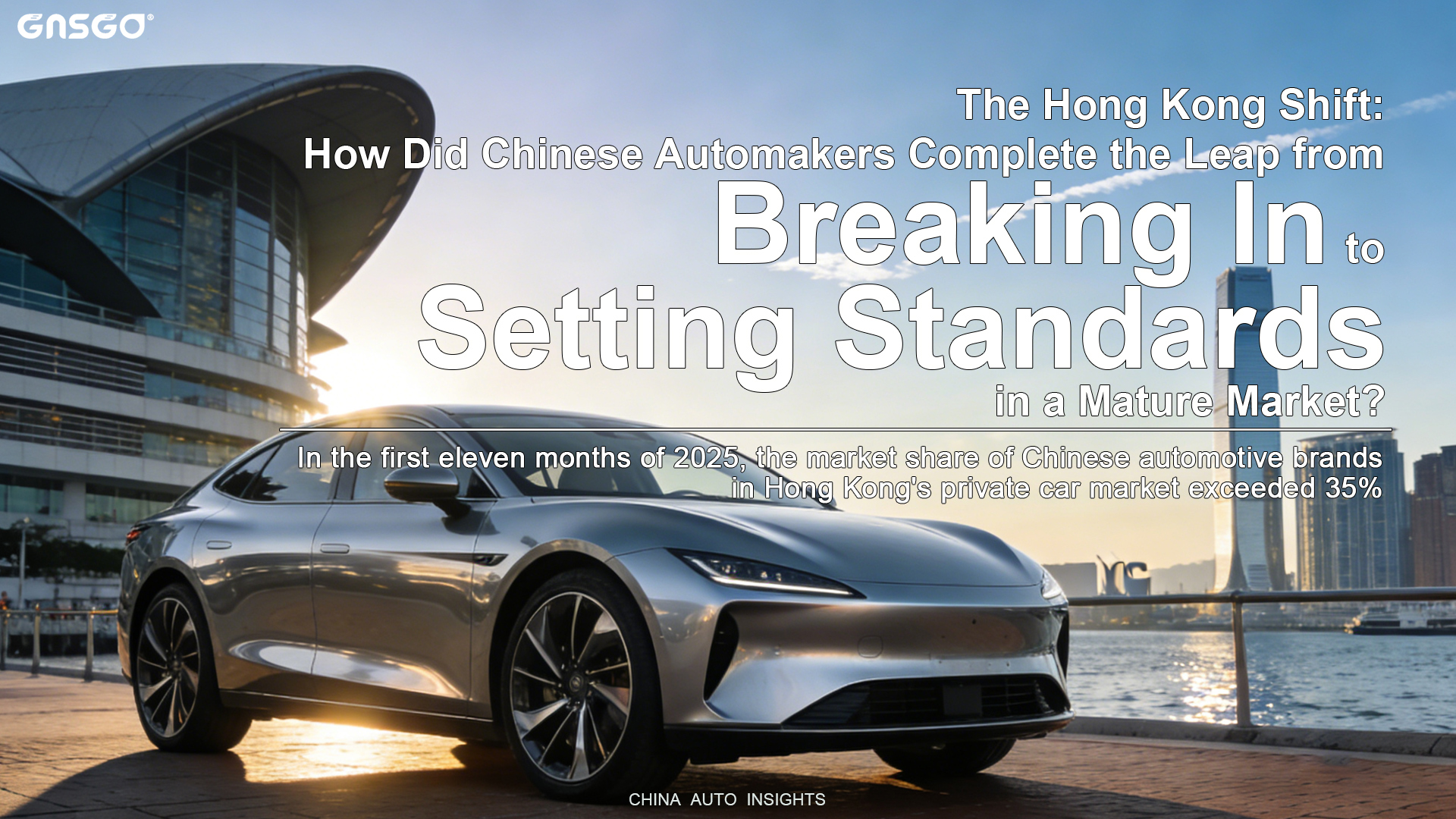
Structural Overturn: In the first eleven months of 2025, the market share of Chinese automotive brands in Hong Kong’s private car market exceeded 35%, doubling from 2024 and completely shattering the long-standing monopoly held by Japanese and German brands.
Comprehensive Leadership: Chinese brands occupied six spots in the top ten sales rankings. BYD (including DENZA) dominated with a market share exceeding 30%. Zeekr, AION, and XPENG broke into the top five for the first time, while Japanese leader Toyota fell out of the top five.
Category Victory: Achieved comprehensive substitution of traditional benchmarks in key segments. The BYD Sealion 07 EV became the best-selling model across the entire market. In the premium MPV segment, the Zeekr 009, DENZA D9, and XPENG X9 have replaced the Toyota Alphard as the new sales leaders.
In-Depth Analysis
Conquering the “High-Value Ground”: Reconstructing Benchmarks in Segments True market dominance is reflected in the battle for the right to define high-value, high-reputation segments. Hong Kong’s premium MPV market (represented by the Toyota Alphard) has always been the ultimate proving ground for brand status and product premium capability. In 2025, Chinese NEV MPVs like the Zeekr 009, DENZA D9, and XPENG X9 not only gained a foothold but also surpassed it in sales. This signals a profound shift in “value definition power”: from the ICE era’s “imported brand aura + social symbol” to the smart EV era’s “comprehensive luxury experience + democratized cutting-edge technology.” The victory of Chinese brands here proves their capability to engage in product definition and brand dialogue at the highest level. Beyond the “Sales Springboard”: Building a “Global Capability Incubator” Hong Kong’s strategic value extends far beyond tens of thousands of annual vehicle sales. Chinese brands are turning it into a “global capability incubator” and an “ecological hub.” First, as a mature RHD market, Hong Kong provides an invaluable “RHD capability” proving ground for all Chinese automakers. The end-to-end experience—from product R&D and production to marketing and service—can be directly and seamlessly replicated in vast RHD markets like Southeast Asia and Australia/New Zealand. Second, as an international financial, information, and cultural hub, Hong Kong serves as an ideal window for Chinese brands to showcase a premium image, access international capital, and attract global talent. This marks the evolution of Chinese automotive globalization from “finding markets” to a new stage of “building a global operational system.”
Industry Insight
The highest level of localization is becoming part of the local “social life solution.” The success of Chinese brands in Hong Kong lies not only in launching RHD vehicles but in deeply integrating into local life scenarios: offering “Northbound Travel for Hong Kong Vehicles” service packages to solve cross-border pain points; building dense supercharging networks to alleviate range anxiety; even optimizing product design for narrow-road maneuverability. This strategy of “deep scenario integration” transforms brands from “outsiders” into “insiders,” forming the foundation for long-term customer loyalty.
Success in a single market should serve the construction of a global “capability platform.” The strategic value of Hong Kong lies in it being a “comprehensive training ground” covering RHD engineering, premium marketing, international compliance, and cross-border services. Automakers should modularize and systematize the capabilities accumulated here to form a rapidly replicable “global capability platform.” In the future, entering any new market can involve flexibly deploying these validated modules from this platform, enabling efficient and low-risk expansion.
HongKongAutoMarket ChineseAutoGlobalization BYD PremiumMPV RightHandDrive BrandGlobalization ElectricVehicles HongKongCarMarket