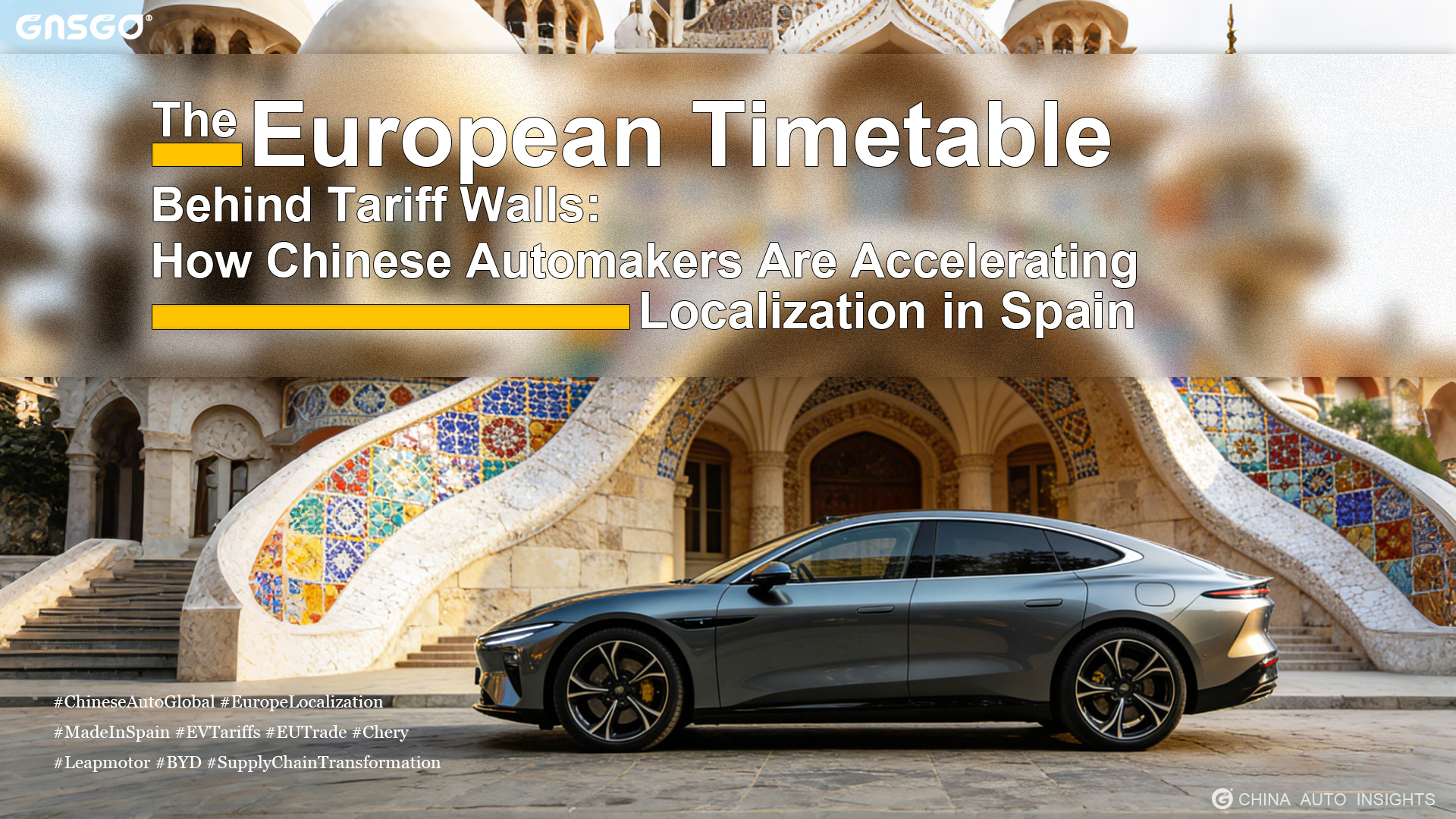
Behind Tariff Walls: China's European Timetable
Core Events & Trends
The EU’s provisional countervailing duties on Chinese electric vehicles act as a mirror—reflecting both the sharpness of trade friction and the clear direction of industrial transformation. In 2025, Chinese automakers saw their European sales surge 99% year-on-year, with market share climbing to a record 6.1% and monthly sales exceeding 100,000 units for the first time. With the implementation of the “price undertaking” mechanism (committing to export prices above a certain level to avoid high tariffs) creating a more predictable trade environment, Chinese automakers’ localization production plans are rapidly accelerating from blueprint to reality. At the factory in Szeged, Hungary, BYD’s assembly lines have begun trial production, with the first “Made in Europe” model set to be the Dolphin Surf.
In-Depth Analysis: Why Is Spain Becoming the “New Anchor” for Chinese Automakers?
Initially, the primary driver for establishing plants in Europe was tariff avoidance. However, the Spanish case demonstrates a profound evolution in this logic. Leveraging the EU’s “Next Generation EU” recovery funds, Spain launched the PERTE VEC Electric Vehicle Industry Support Program, followed by the “Spain Automotive 2030 Plan,” aiming to build a comprehensive industrial ecosystem encompassing vehicle manufacturing, battery supply chains, and R&D innovation. For Chinese automakers, this is no longer simple capacity transfer but a necessity to establish full-chain localization capabilities—including R&D, supply chain, and services—right here, creating local value and employment compliant with EU rules. As emphasized by the “Auto+ Plan,” securing long-term competitiveness in Spain and the broader European market requires meeting policy demands for increasingly stringent “European value content” through genuine local manufacturing. This means that investing in production facilities in Spain is a preemptive investment to secure a “passport for market access” and a “ticket to compete” in the European market for the next decade.
Industry Insights
For Chinese Automakers: The Spanish experience reveals that the future European strategy must be a duet between “manufacturing localization” and “value ecosystem integration.” Factories built solely to circumvent tariffs will be unsustainable. Only those companies that deeply integrate into the local industrial ecosystem, create jobs and technology spillovers, and build sustainable local supply chains will gain long-term political acceptance and market trust. Choosing Spain is not just selecting a production base; it is choosing a development model deeply integrated with European industrial policy.
For the European Auto Industry: The transformation unfolding in Spain is a clear signal. Chinese automakers bring not only competitive pressure but also the capital and technological force capable of reshaping the regional industrial landscape. From Chery revitalizing idle capacity, to Leapmotor’s deep integration with Stellantis, to massive investments surrounding the battery industry, Chinese players are becoming a key variable in activating Southern Europe’s automotive industrial belt and accelerating its electrification transition. European incumbent automakers need to rethink how to find accelerators for their own transformation within a new balance of cooperation and competition.
ChineseAutoGlobal EuropeLocalization MadeInSpain EVTariffs EUTrade Chery Leapmotor BYD SupplyChainTransformation