Kyrgyzstan Becomes Central Asia's Biggest Buyer
Core Data/Events
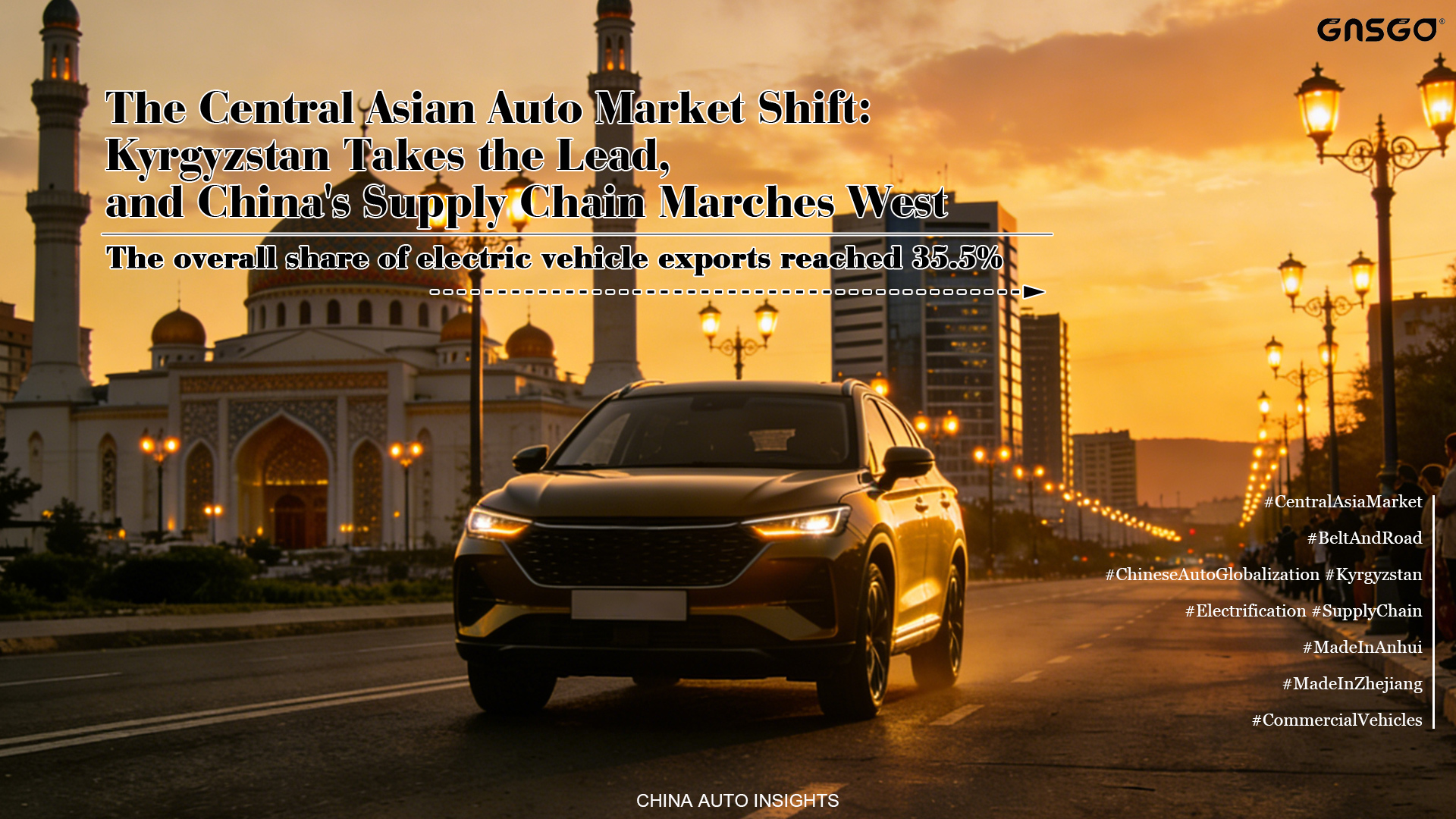
Overall Growth: In November 2025, China’s automobile exports to the five Central Asian countries reached 57,460 units, a month-on-month increase of 11.2%, hitting a yearly high. Cumulative exports from Jan-Nov exceeded 420,000 units, demonstrating strong market momentum. Structural Shift: Kyrgyzstan, with purchases of 21,350 units, surpassed Kazakhstan for the first time to become Central Asia’s largest buyer, accounting for 37.2% of the regional share. Uzbekistan showed the fastest growth (MoM +36.2%). Electrification Progress: The overall share of electric vehicle exports reached 35.5%. Within passenger vehicles, electric vehicles already account for 40.5%, indicating an accelerating electrification trend in Central Asia.
In-Depth Analysis
Reshaping Market Structure: The “Corridor Economy” Fosters a New Hub
Kyrgyzstan’s rise to the top is not merely the emergence of a consumer market but reflects its value as a key node in the “Central Asian Logistics Corridor.” Compared to Kazakhstan with its stronger industrial base, Kyrgyzstan, leveraging more flexible trade policies and location, is evolving from a “transit passage” into a “automotive trade and distribution hub” for all of Central Asia and Russia. This signals that China’s auto export path to Central Asia is evolving from traditional point-to-point sales to a more complex “hub-and-spoke” network trade.
Electrification Penetration: A “Gradual Revolution” Aligned with Market Reality
Central Asia’s 35.5% EV share is higher than many traditional emerging markets, but the process is unique. Electrification is primarily driven by passenger vehicles (40.5% share), while commercial vehicle electrification has barely begun (only 0.8% share). This deeply reflects regional realities: household cars are sensitive to operating costs, and low electricity prices make EVs advantageous; the commercial sector, due to range, charging infrastructure, and heavy-load demands, remains dominated by ICE vehicles. This “passenger-EV, commercial-ICE” dual structure requires automakers to offer differentiated product portfolios, not a single bet on electrification.
Industry Insights
The strategic value of the Central Asian market has upgraded from a “sales destination” to a “land hub and proving ground.” Companies should not view it only as a regional market of 60 million people but also recognize its value as the core land corridor of the Belt and Road and a springboard radiating into the Eurasian hinterland. Simultaneously, its diverse national composition and differentiated demands (e.g., Uzbekistan’s demographic dividend, Kazakhstan’s industrial needs) make it a “natural proving ground” for testing product adaptability and business model resilience. For the “dual market,” a precise strategy of “parallel development of ICE and EV lines” is required. For the coming years, ICE vehicles will remain the foundation, especially in commercial vehicles. However, the window for electrification is opening, particularly in the household vehicle segment. Successful automakers need to “balance both hands”: one hand continuously optimizing cost-effective, highly adaptable ICE products; the other proactively developing Central Asia-specific EV models suited for cold climates and underdeveloped charging networks, seizing the mental high ground.
CentralAsiaMarket BeltAndRoad ChineseAutoGlobalization Kyrgyzstan Electrification SupplyChain MadeInAnhui MadeInZhejiang CommercialVehicles