Morocco's Car Sales Jump 36%
Core Data/Events
-
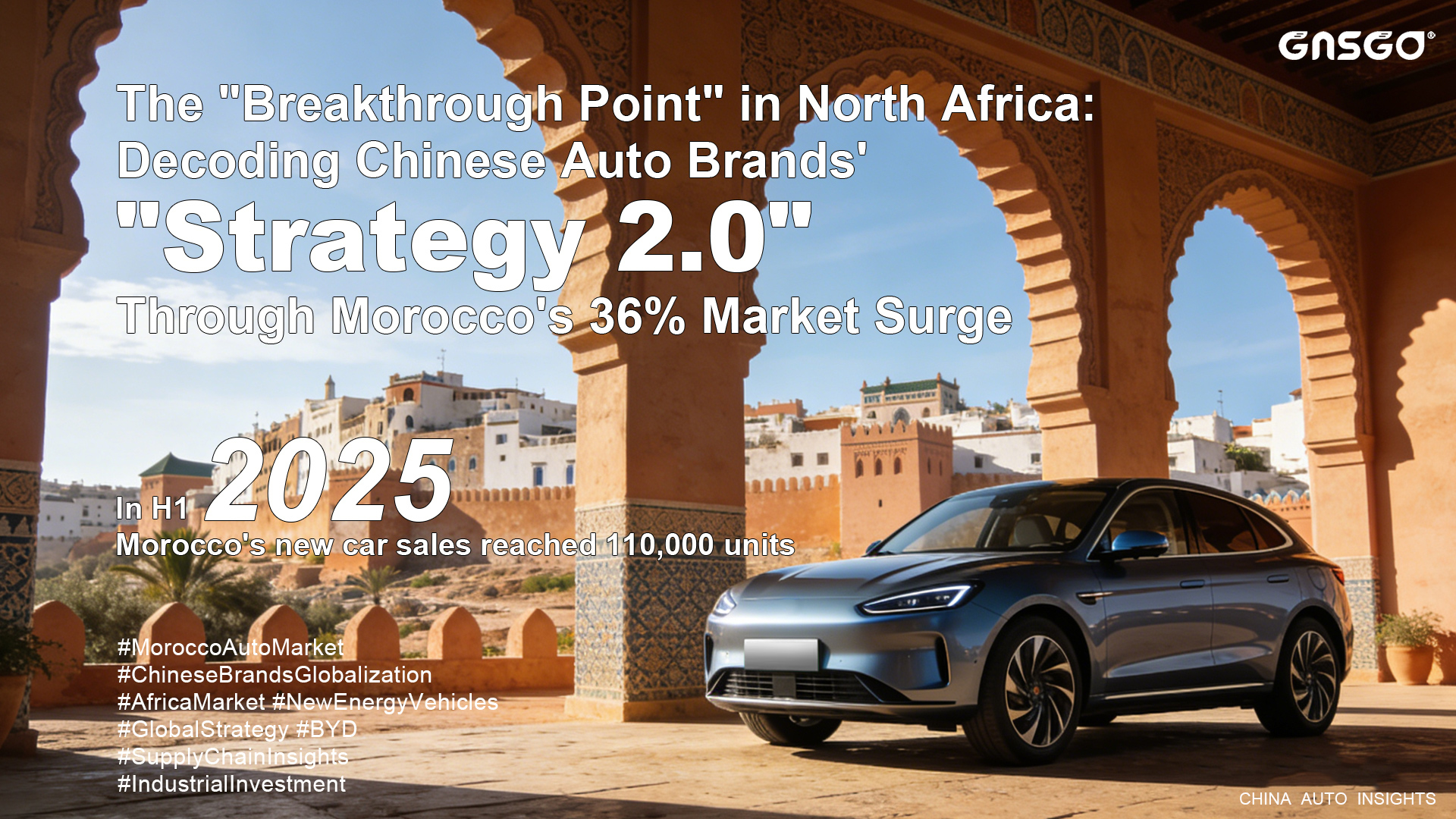
In H1 2025, Morocco’s new car sales reached 110,000 units, a year-on-year increase of 36%. While attributed by local associations to loose credit and new models, the underlying driver is the onset of structural market change.
-
In June 2025, combined monthly sales of major Chinese brands like BYD, Geely, and Changan in Morocco exceeded 890 units, forming an initial cluster effect in a market long dominated by French brands.
-
The Moroccan government offers strong incentives for EVs, including VAT exemption, an 80% tariff reduction, and purchase subsidies up to $10,000 for businesses, paving the way for Chinese EVs with first-mover advantage.
-
Morocco is not only Africa’s largest auto manufacturer (industry exports: 174 billion MAD in 2024) but also holds nearly 75% of global phosphate reserves and commands the Strait of Gibraltar, possessing unique potential to become a regional hub for NEV manufacturing and export.
In-Depth Analysis
- The actions of Chinese brands in Morocco clearly demonstrate an upgraded globalization model:
◇1.0 Product Trade: Quickly introducing products through major local distributors (e.g., Auto Nejma for BYD) for market testing. ◇2.0 System Localization: Actively building localized distribution and after-sales networks for sales; conducting high-profile marketing via ads, auto shows, and test drives for branding. This is no longer just selling cars but beginning to build brand recognition and service systems. ◇Forward-looking 3.0 Value Chain Extension: Given Morocco’s phosphate reserves (key for batteries), duty-free export agreements with Europe, and existing automotive industrial base, it has the potential to leap from a “sales market” to a “localized NEV manufacturing and export hub.
- Strategic Re-evaluation of the “North African Hub”
◇Morocco’s value must be assessed within the global automotive supply chain restructuring. For the Chinese auto industry, it could play three roles: first, a high-quality springboard into the vast but complex African market; ◇Second, an “overseas capacity pivot” leveraging its free trade agreements with the EU and US to bypass trade barriers; third, a potential partner for upstream localized battery raw material processing due to its phosphate resources.
Industry Insights
- Target “Dynamically Growing, Unsettled” Markets for Globalization. Compared to saturated, price-war markets, targeting markets like Morocco—with growing economies, clear policy direction, and a fluid competitive landscape—offers Chinese brands higher strategic returns and brand-building space.
MoroccoAutoMarket ChineseBrandsGlobalization AfricaMarket NewEnergyVehicles GlobalStrategy BYD SupplyChainInsights IndustrialInvestment