Saudi Arabia Runs 90 Yutong Electric Buses
Core Data/Events
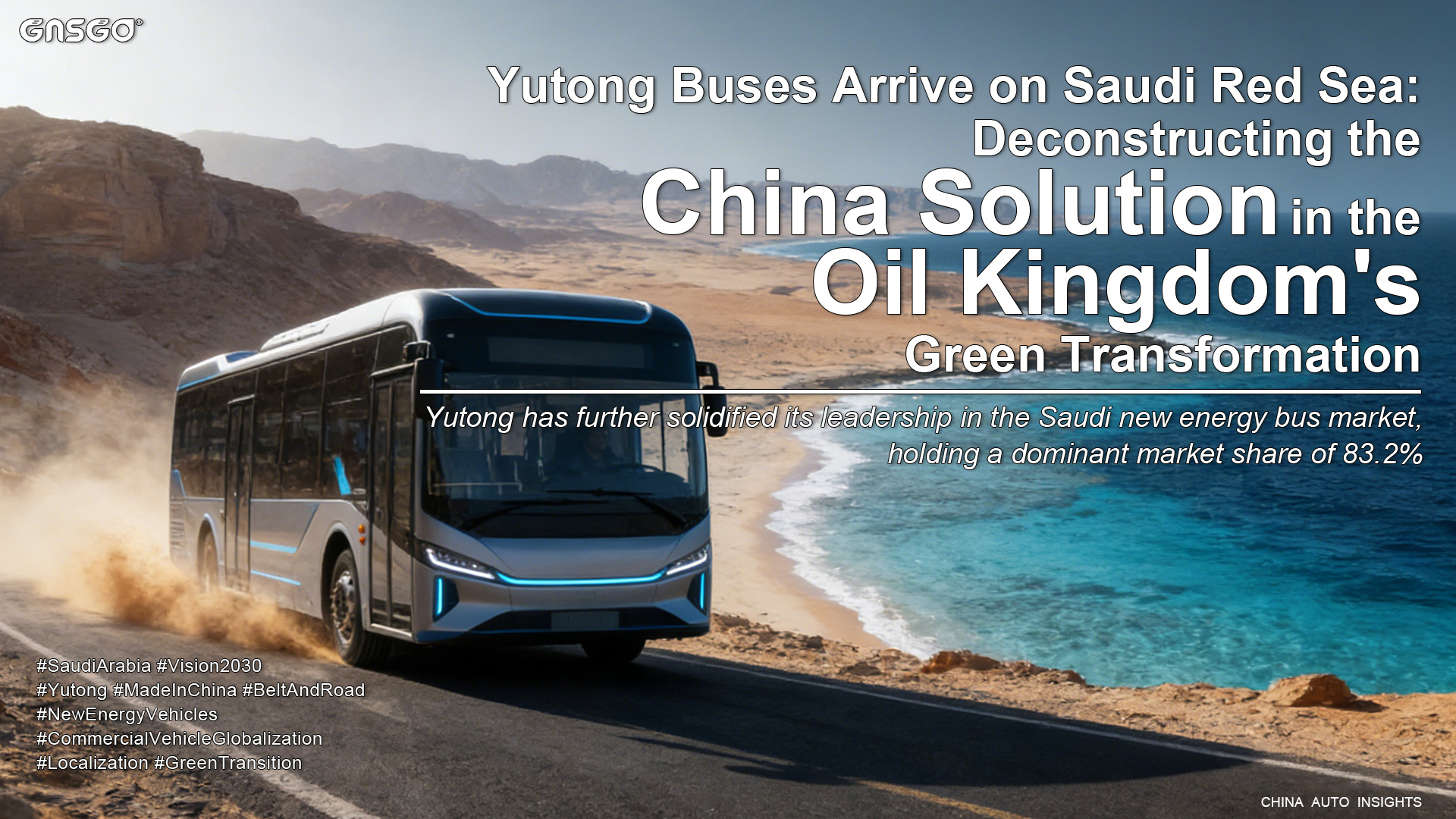
Recently, the first 90 units of nearly 200 Yutong pure electric buses procured by Saudi Arabia’s Red Sea Global Group and SIXT have officially commenced operation in the Saudi Red Sea region. This batch includes 12-meter, 9-meter, and high-end VIP customized models, serving diverse scenarios such as tourist shuttles and daily commuting. With this delivery, Yutong has further solidified its leadership in the Saudi new energy bus market, holding a dominant market share of 83.2%. Its share in government-led long-distance passenger transport projects also exceeds 65%, with airport shuttle buses operating at all major Saudi airports.
In-Depth Analysis
Yutong’s success in Saudi Arabia extends far beyond selling 200 buses. At its core, it represents a leap from “selling vehicles” to “delivering a systemic transportation solution adapted to extreme environments.” To address the harsh conditions of high temperature, humidity, and salinity in the Red Sea region, Yutong implemented comprehensive, deep customization across the entire chain—from the three-electric systems (IP68+IP6K9K protection) and drive motors (sand-proof, anti-condensation) to battery thermal management (liquid-cooled self-start). This validates that Chinese high-end manufacturing now possesses the capability for “precision R&D” tailored to the unique operating conditions of any corner of the globe, exporting verified product definition power and technical standards. The profound significance of this delivery lies in its location—the “Red Sea Project.” This is not an ordinary transit route but a national showcase and testing ground for the future, into which Saudi Arabia is channeling immense resources. Yutong’s electric buses will become the green lifeblood flowing through the arteries of this “city of the future.” This signifies that the products and image of Chinese brands are now deeply embedded in the core narrative of Saudi Arabia’s transformation. This lays an irreplaceable foundation of trust and a first-mover advantage for Yutong and subsequent Chinese automakers to participate in Saudi Arabia’s broader initiatives, such as smart transportation (e.g., autonomous taxi pilots) and green energy networks.
Industry Insights
Chinese automakers going global must excel at “boarding” the host country’s national strategic express. Whether it’s Saudi Arabia’s Vision 2030 or Kazakhstan’s industrialization policies, immense industrial opportunities are embedded within. The key to success lies in precisely aligning one’s own product and technology roadmap with the host country’s core needs, such as employment, technology transfer, industrial upgrading, and green transformation. Yutong’s response through localized KD assembly cooperation directly addresses these needs, resulting in its high market share and policy support. Commercial vehicles serve as the “strategic vanguard” and “trust cornerstone” for passenger vehicle globalization. Compared to passenger cars, commercial products like electric buses and trucks more directly serve a country’s infrastructure and public welfare. Yutong’s full-scenario coverage in Saudi Arabia—from airports and long-distance passenger transport to high-end commuting—essentially establishes comprehensive, high-frequency physical touchpoints and reliability perception for Chinese manufacturing in Saudi Arabia. The profound trust built on this B2B and B2G (business-to-government) foundation will significantly lower the cognitive barriers and trust costs for subsequent Chinese passenger car brands entering this market.
SaudiArabia Vision2030 Yutong MadeInChina BeltAndRoad NewEnergyVehicles CommercialVehicleGlobalization Localization GreenTransition