BYD Rises to Sixth Among Korea's Import Brands
Core Data/Events
-
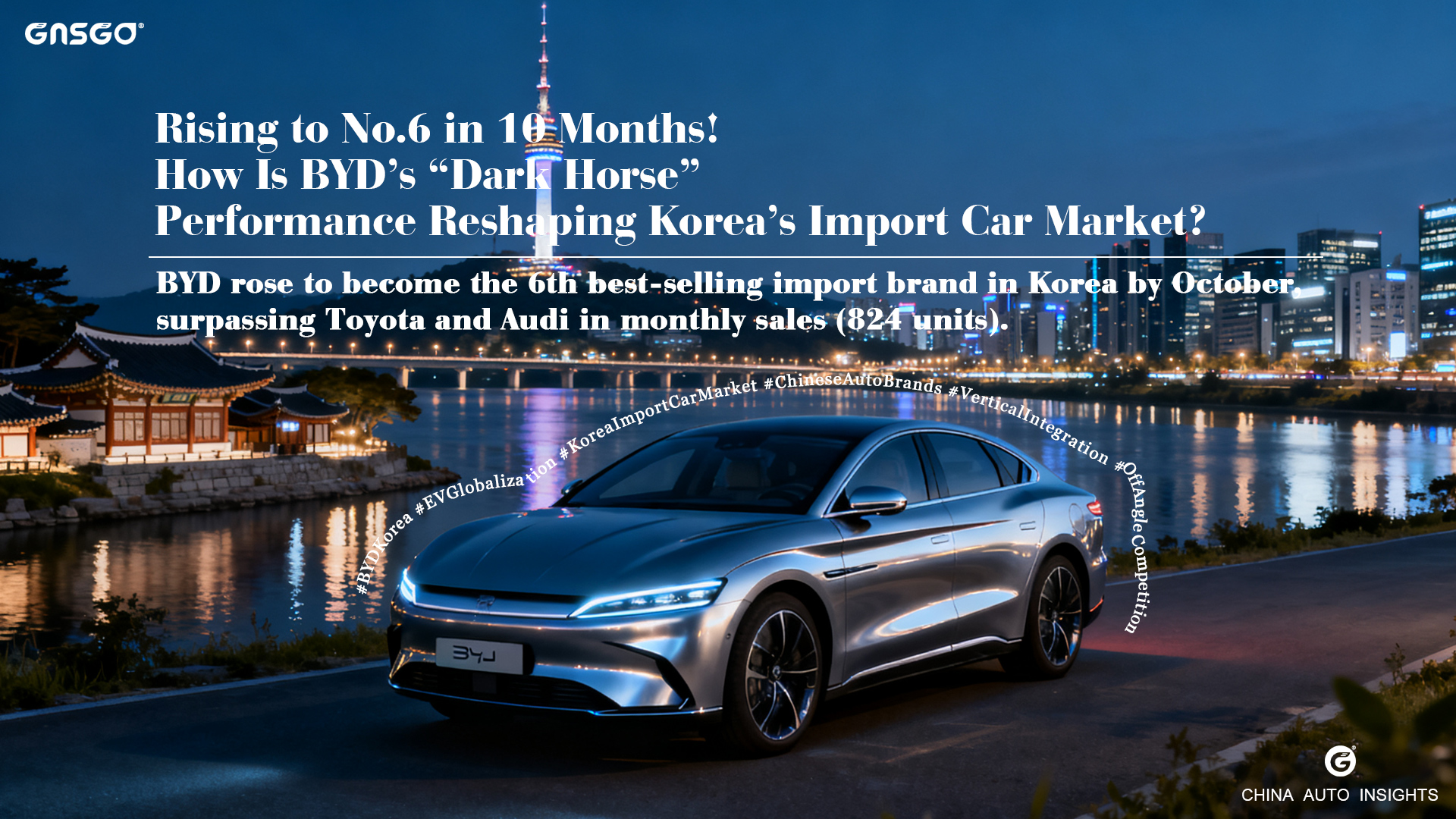
Ranking Leap: Since entering the Korean market in January 2025, BYD rose to become the 6th best-selling import brand in Korea by October, surpassing Toyota and Audi in monthly sales (824 units).
-
Growth Trajectory: Following the April launch of the ATTO 3 (543 units, ranked 11th), sales climbed steadily with the launches of the Seal (Sept) and Sealion 7 (Sept), exceeding Toyota’s sales in September (1,020 units).
-
Market Context: BYD achieved counter-trend growth and increased market share in October, despite the overall import car market declining 26.7% month-on-month.
In-Depth Analysis
-
Precise “Product Portfolio” and Market Timing,Instead of a single model, BYD launched three models within 7 months (ATTO 3, Seal, Sealion 7), covering key segments (compact SUV, mid-size sedan, mid-size SUV). This multi-pronged attack quickly built brand awareness and catered to diverse needs.
-
BYD’s core strength lies in vertical integration, controlling battery, motor, and electronic control production in-house. This grants it a significant cost advantage over many traditional automakers and some EV startups.As a Chinese brand, its production base’s proximity to Korea offers inherent advantages in logistics cost and supply chain responsiveness compared to imports from Europe or the US, further solidifying its price competitiveness.
-
Industry observers note BYD currently targets the “affordable EV” segment, creating a customer group misalignment with traditional import brands like BMW, Mercedes-Benz, and Audi that focus on the luxury market. This allowed its initial growth without facing direct confrontation from incumbents.
Industry Insights
-
BYD’s case in Korea demonstrates that a clear product portfolio, extreme cost control, and precise differentiated positioning can rapidly open up a new market. This offers a reference “agile entry” model for other Chinese brands.
-
The Korean market has long been dominated by domestic brands (Hyundai, Kia) and European luxury imports. BYD’s rise may signal the maturation of a new “high-value smart EV” segment, potentially altering competitive dynamics and forcing all players to rethink product and pricing strategies.
-
Focus on the sustainability of BYD’s market share in Korea and whether its brand image can successfully move beyond “affordable.” Also, monitor how Korean domestic brands and other importers respond to this new challenger.
What do you think is the core of BYD’s success in Korea: “price advantage” or “product capability”? How replicable is this model in other developed markets (e.g., Japan, Australia)?
BYDKorea EVGlobalization KoreaImportCarMarket ChineseAutoBrands VerticalIntegration OffAngleCompetition