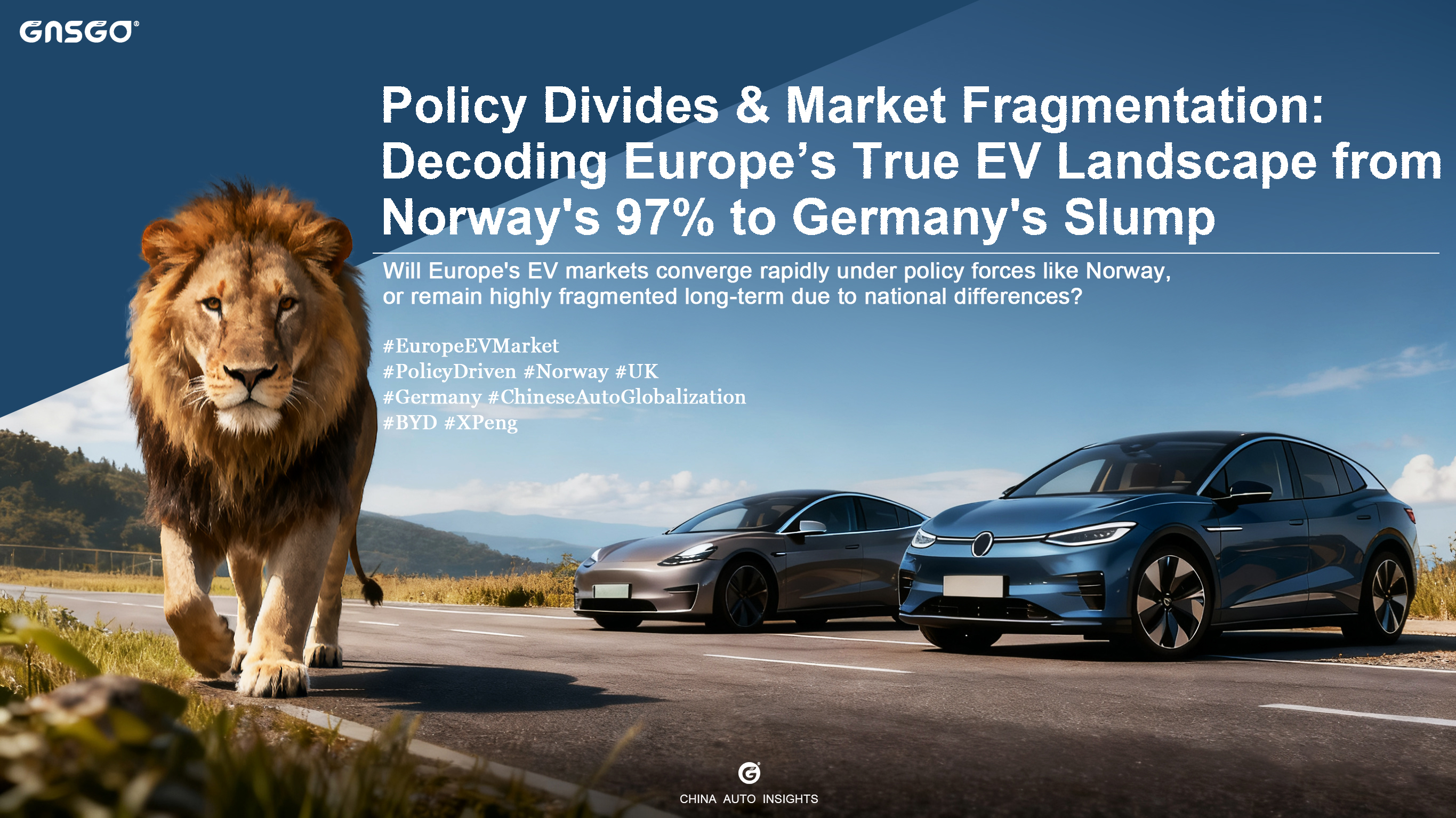
Europe's EV Map: Norway at 97%, Divisions Below
Core Data/Events
-
Norway (Benchmark): BEV penetration hit 97% in Apr 2025; Chinese brands captured nearly 10% share in 2024.
-
UK (Policy-Driven): 2024 BEV sales reached 382,000 units, surpassing Germany as Europe’s largest market; BYD sales soared 659% YoY.
-
Germany (Subsidy Withdrawal): 2024 BEV sales were 380,600 units, down over 25% YoY, with penetration at only 13.5%.
-
EU (Overall Lag): BEV penetration remained below 15% in 2024, with stark divergence: Belgium’s sales surged 37% due to extended subsidies.
In-Depth Analysis
-
Norway’s aggressive tax regime and the UK’s ZEV Mandate have shaped high-penetration markets through economic incentives and forced supply, respectively;Germany’s complete subsidy withdrawal caused an immediate demand cliff, exposing deep policy dependence and fragile organic demand. The asynchronous policies across EU member states are the primary cause of the slow and uneven overall transition.
-
Chinese brands (e.g., XPeng) compete directly with mainstream EVs (e.g., VW ID.4, Toyota bZ4X) in the mid-to-high-end segment with a “value-tech-design” proposition, contesting for existing market share;Chinese brands (e.g., BYD, Chery) leveraged the policy-driven explosive window, rapidly scaling sales through dealer networks. Their success capitalizes on the market gap left by traditional brands’ slower adjustment.
Industry Insights
-
When evaluating the European EV sector, policy stability and continuity should be a higher priority than total market size. Short-term focus should be on brands capable of rapid scaling under policies like the UK’s ZEV Mandate; long-term focus should identify firms with profitable products even in subsidy-free environments.
-
The fragmentation and volatility of the European EV market demand greater flexibility from the supply chain. Battery and component suppliers must support both mass production for premium models and cost-optimized solutions for mass-market segments.
EuropeEVMarket PolicyDriven Norway UK Germany ChineseAutoGlobalization BYD XPeng