Leapmotor Reaches Nine European Markets in a Year
Core Data/Events
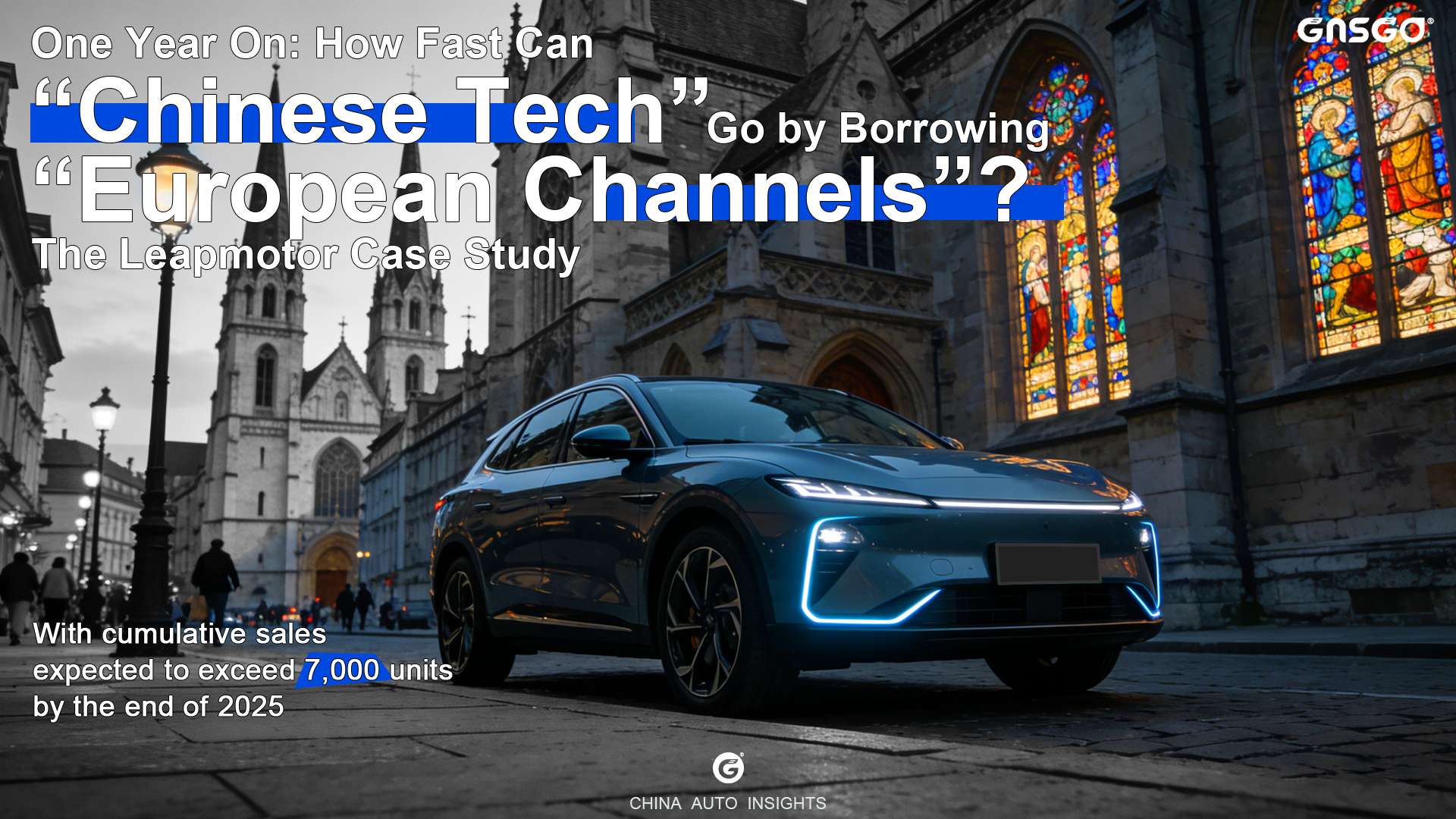
Through its joint venture with Stellantis, Leapmotor entered nine European markets, including Germany, within a year. Germany has become its largest European market, with cumulative sales expected to exceed 7,000 units by the end of 2025, over 70% of which are from private customers.
The main model T03 starts at around €18,900, precisely filling the gap in the €20,000 pure-electric small car segment. The follow-up C-segment model B10 continues the “fully-equipped at a competitive price” strategy and is scheduled for localized production at Stellantis’s Spanish plant in Q4 2026.
Instead of direct sales, Leapmotor fully leverages Stellantis’s established network of over 700 European dealerships (over 120 in Germany) and an efficient parts logistics system for rapid market coverage.
In-Depth Analysis
The Leapmotor-Stellantis partnership is essentially an efficient exchange of “Chinese electrification product power” for “European century-old channel and trust assets.” Leapmotor avoids the massive capital and time required to build its own network, gaining immediate access to high-quality market touchpoints and mature after-sales logistics (e.g., 24-hour parts delivery). Stellantis, in turn, leverages its surplus channel resources to quickly acquire a highly price-competitive pure-electric product line, filling its entry-level market gap. This model of “light-asset parasitism, heavy product export” provides a “fast track” for Chinese automakers with technical advantages but weak brand recognition to penetrate European market barriers. Leapmotor’s success is not merely “attaching” to dealerships. The deeper logic lies in constructing a closed-loop system that “makes partners profitable and secure.” First, its product positioning (“more affordable and better-equipped in the same segment”) brings clear incremental customer flow and profit to dealers. Second, the deeply integrated JV model with Stellantis (equity stake, exclusive rights, shared manufacturing) aligns interests completely, avoiding short-term gamesmanship common in traditional distribution. Finally, leveraging Stellantis’s central warehouse and parts centers addresses dealers’ paramount concern: after-sales support and parts availability, establishing a “trust closed-loop.” This elevates the cooperation beyond loose distribution to deep integration of supply chains and interests. The Leapmotor model provides a template for similar Chinese brands, but its replicability has strict prerequisites: there must be strong strategic complementarity with no direct business conflict between partners. It also places extremely high demands on the Chinese company’s product definition, cost control, and collaborative operational capabilities.
Industry Insights
In the Globalization 3.0 Era, “Product Export” Must Evolve into “Ecosystem Integration.” The Leapmotor case signifies an evolution in Chinese automakers’ European strategies: from the 1.0 era of simple trade exports, to the 2.0 era of independent brand operations (e.g., BYD, MG), to the 3.0 era of “deep integration with local industrial giants.” Future competition will be not only about product power but also about the ability to rapidly integrate and leverage mature overseas industrial ecosystems. Choosing a “Host” Partner Hinges on Creating Irreplaceable Incremental Value. For automakers seeking a similar path, the core question is not “who needs me?” but “what unique and substantial incremental value can I bring to the partner’s ecosystem?” Leapmotor’s value lies in injecting entirely new customer flow and profit into Stellantis’s dealer network with its cost-effective products. This value must be clear, quantifiable, and difficult for the partner to replicate internally.
Leapmotor Stellantis ChineseAutoGlobalization EuropeanMarket AutomotiveDistribution ElectricVehicles JointVenture SupplyChain GermanyMarket