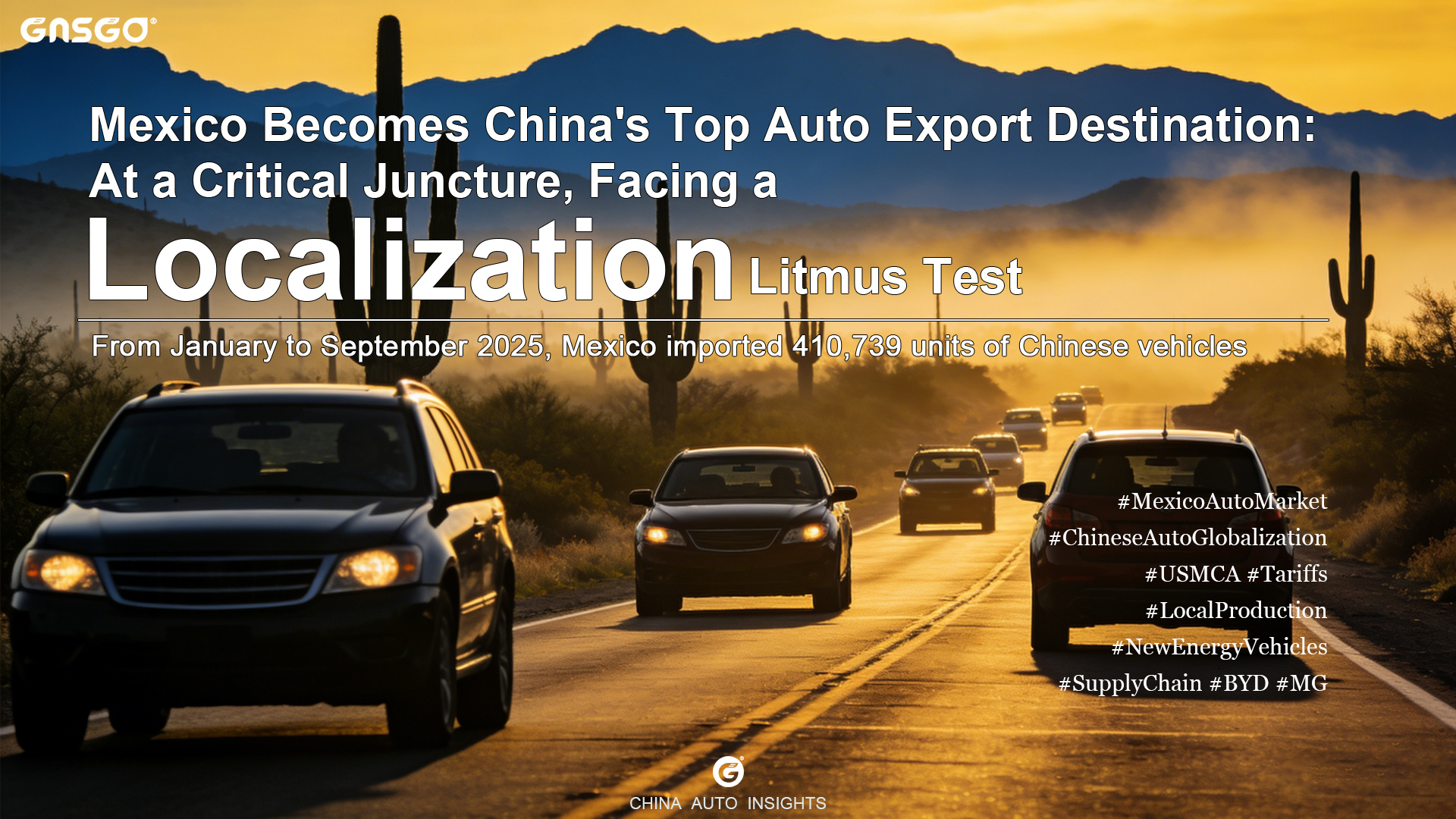
Mexico Becomes China's Top Export Destination
Core Data/Events
Claiming the Top Spot: From January to September 2025, Mexico imported 410,739 units of Chinese vehicles, surpassing Russia and the UAE to become China’s number one automobile export destination. This marks a significant shift in the focal point of Chinese automotive globalization.
Structural Growth: New energy vehicles are the core driver. In the Mexican market, Chinese NEVs have replaced traditional internal combustion engine vehicles as the primary growth driver. It is estimated that from January to November 2025, new energy vehicles accounted for over 45% of China’s vehicle exports to Mexico.
Imminent Challenge: The Mexican Congress has approved a new tariff bill. Effective January 1, 2026, additional tariffs ranging from 5% to 50% will be imposed on automobiles and parts from countries without free trade agreements with Mexico, including China.Vehicle tariffs can reach as high as 50% (currently around 20%), and parts tariffs range from 20% to 35%.
Industry Insights
Re-evaluating the “Mexican Role”: From “Export Destination” to “North American Strategic Pivot”. Companies must abandon the notion of Mexico as a simple sales market and reposition it as a regional manufacturing and supply chain hub face the entire North American market. Investments here are valuable not only for local sales but also for obtaining a “compliance ticket” to the US market and enhancing supply chain resilience. Localization is a Systematic Project, Requiring ” vehicle and Supply Chain” Collaborative Globalization. Successful localization is by no means establishing an isolated assembly plant. It requires vehicle companies to drive a group of core component suppliers to jointly establish operations, forming an initial industrial cluster in Mexico. This can reduce logistics and tariff costs and fundamentally resolve political and policy risks by creating more local employment and value. Competition Dimensions Upgrade, from “Cost-Performance” to “Technology Premium and Brand Value”. When price advantages are eroded by tariffs, competition will shift more towards the technological uniqueness of the product itself, brand experience, and after-sales service networks. Chinese brands need to leverage their first-mover advantages in electrification and intelligence to create irreplaceable product value and establish strong localized service systems to win consumers even in a high-cost environment.
MexicoAutoMarket ChineseAutoGlobalization USMCA Tariffs LocalProduction NewEnergyVehicles SupplyChain BYD MG