Latin America: 186,395 Units in a Single Month
Core Data/Events
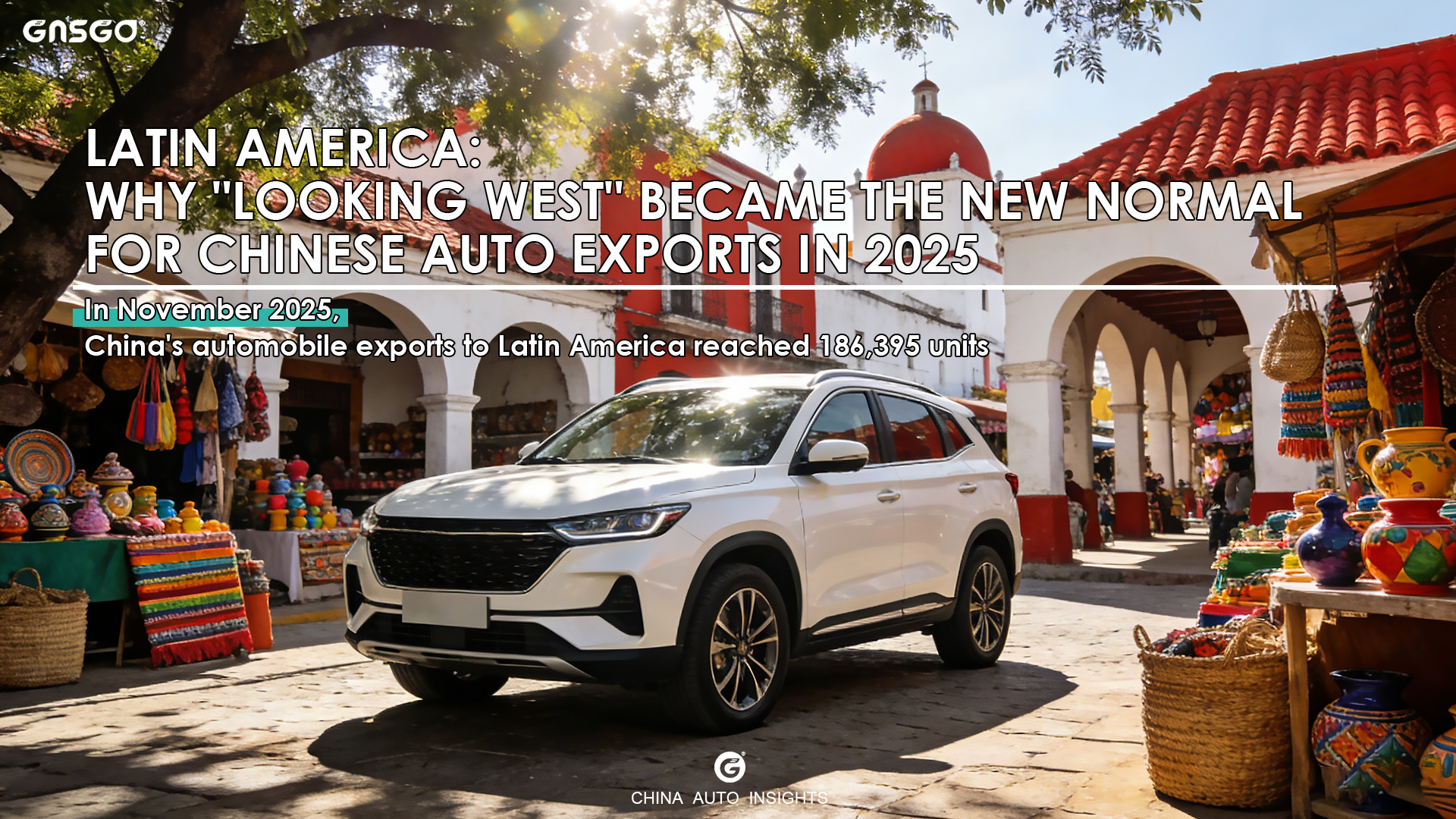
Strategic New Frontier: In November 2025, China’s automobile exports to Latin America reached 186,395 units, a month-on-month increase of 5.3%, accounting for 22.8% of China’s total monthly exports, hitting a yearly high. Cumulative exports from Jan-Nov surpassed 1.456 million units, showing significant year-on-year growth. Electrification Vanguard: Among exported passenger vehicles, new energy vehicles already account for 56.4%. Plug-in hybrids (PHEV) have the highest share (47%), while pure electric vehicles (BEV) account for 42%, indicating hybrid technology is becoming the vanguard. One Superpower, Multiple Strong Players: Mexico firmly leads with monthly purchases of 90,155 units, commanding 48.4% of the Latin American market. Markets like Brazil, Chile, and Uruguay together form a diversified “fundamental base.”
In-Depth Analysis
Structural Shift: From “Dumping Ground for ICE Vehicles” to “Proving Ground for New Energy”
The Latin American market is undergoing a fundamental role change. It was once seen as a “value depression” for absorbing China’s surplus internal combustion engine vehicle capacity. However, 2025 data reveals a new reality: new energy vehicles now account for over half of exports, with the strong performance of plug-in hybrids (PHEV) precisely addressing local practical pain points like uneven charging infrastructure and user range anxiety. This marks the evolution of Chinese automakers’ globalization from mere cost export to the export of capabilities in precisely matching technological pathways with market demand. Latin America is becoming China’s “open-air laboratory” for validating its diversified new energy solutions.
Solidified Landscape: Mexico’s “Hub” Role and Risk Hedging in Diversified Markets
Mexico’s “superpower” status is no accident. It is not only a massive consumer market but also a strategic springboard and manufacturing hub to North and South America. Chinese brands’ deep cultivation here essentially builds a regional operational center. Meanwhile, monthly fluctuations in markets like Colombia and Brazil highlight the complexity and risks within Latin America. Betting on any single country is risky. A mature globalization strategy must be a combination punch of “using Mexico as a hub to radiate into diversified markets” to hedge against uncertainties brought by political and economic cycles.
Industry Insights
Commercial Vehicles are an Underestimated “Growth Pole” and “Policy Barometer”. Commercial vehicle exports surged 25.9% month-on-month in November, with trucks up 31%, far exceeding passenger vehicle growth. This is not just a commercial opportunity but a crucial economic signal: it directly reflects the investment cycles of Latin American countries in infrastructure construction and logistics system upgrades. Tracking the sales and structural changes of commercial vehicles can provide early insights into regional economic cycles and infrastructure policy trends. Globalization Requires Dual Planning of “Geographic Thinking” and “Network Thinking”. “Geographic thinking” refers to deep cultivation of brand and channels in key countries like Mexico and Brazil. “Network thinking” refers to leveraging the advantages of the Yangtze River Delta’s world-class port cluster like Zhejiang and Jiangsu, transforming China’s eastern coast into an efficient, low-cost automotive export logistics network face the world, especially Latin America. The latter is the physical foundation that enables the former to achieve economies of scale and timeliness.
ChineseAutoGlobalization LatinAmericaMarket Mexico NewEnergyVehicles AutoExports SupplyChain MadeInAnhui Electrification CommercialVehicles