Kazakhstan: 234,852 Cars, 80% Built Locally
Core Data/Events
Market Scale & Structure: Kazakhstan’s auto market reached 234,852 units in 2025, up 14.4% YoY. Notably, 80% of new vehicles were locally produced, with the top 10 best-selling models all manufactured domestically. (Source: Kazakhstan Automobile Industry Union, KAO)
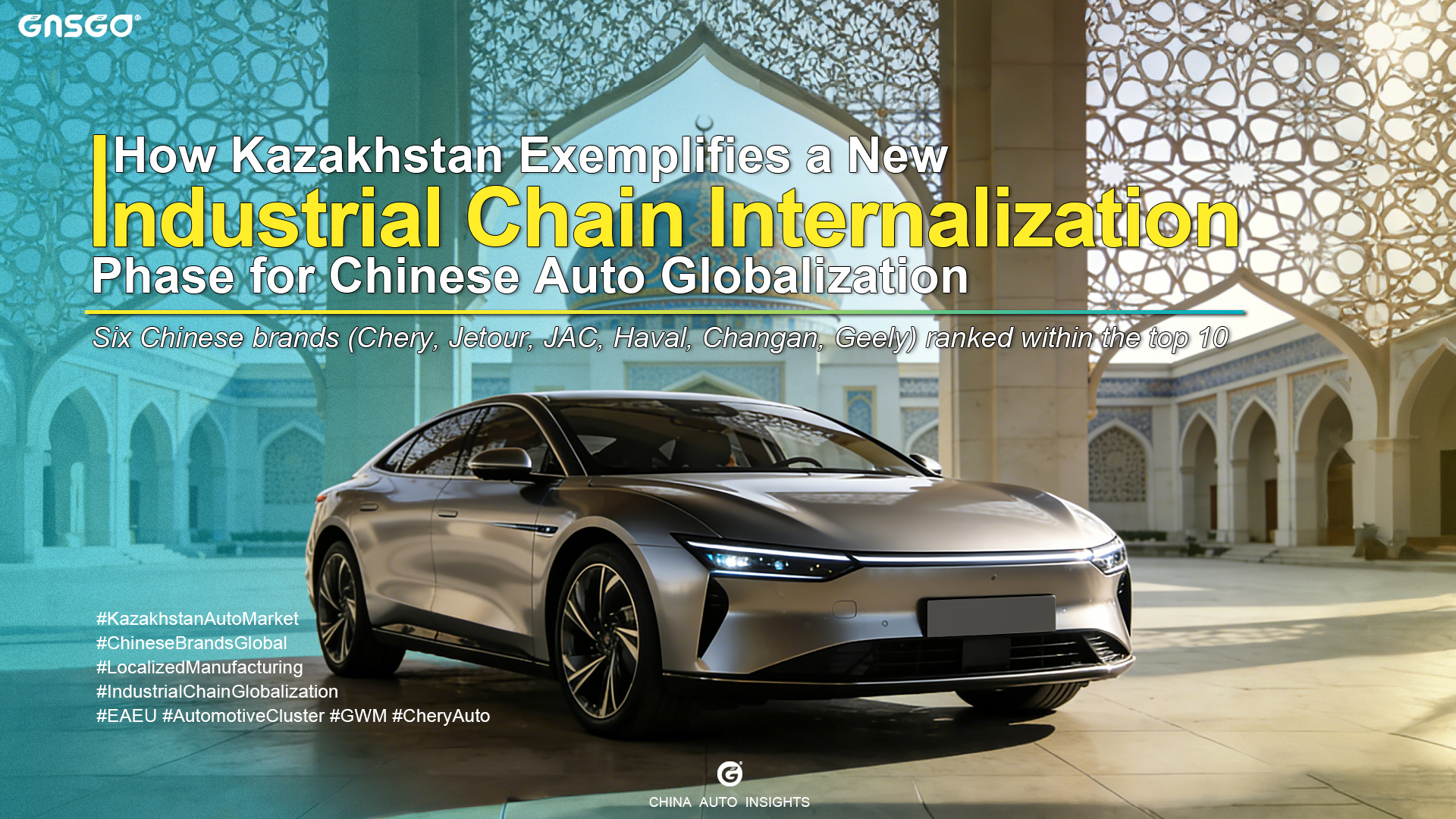
Rise of Chinese Brand Clusters: Chinese brands led all country-of-origin groups with a 35.3% market share. Six Chinese brands (Chery, Jetour, JAC, Haval, Changan, Geely) ranked within the top 10, demonstrating formidable collective strength.
Industrial Investment Materializes: In 2025, the Chery Tiggo 2 and Changan CS55 Plus commenced production at a new plant in Almaty with local certification, signaling a shift from “assembly participation” to “deep localized manufacturing” for Chinese brands.
In-Depth Analysis
Strategic Depth: From “Market Capture” to “Industrial Chain Internalization” The Kazakhstan case vividly illustrates the strategic deepening of Chinese automakers’ global playbook. After gaining share via trade, leading brands are now actively pursuing “industrial chain internalization”—embedding design, production, supply chain management, and employment into the target market through direct investment, technology transfer, and partnerships. The 80% local production rate and six Chinese brands among the top ten models indicate this transcends simple CKD assembly. It represents Chinese OEMs leveraging their mature vehicle platforms, supply chain mastery, and capital strength to jointly reshape the nation’s auto manufacturing landscape in concert with local industrial policy, thereby erecting formidable barriers to entry.
Phase Assessment: Solid ICE Foundation, Strategic Foothold for Electrification The current Kazakh market remains centered on ICE and mild-hybrid vehicles, with NEVs in the nascent stage. Chinese brands’ success is built primarily on high-value SUVs and crossovers targeting mainstream family needs. This reflects a pragmatic strategy: first establish unshakable manufacturing and market dominance in the largest addressable market (ICE). Concurrently, the presence of brands like BYD and Tank, albeit at smaller scales, is not a failure but serves as market education, channel piloting, and brand priming—reserving a critical strategic entry point and brand conduit for the future electrification transition when infrastructure and policy incentives mature.
Industry Insights
For Global Players: The Kazakhstan model demonstrates that in allied or hub countries with sufficient market size and willingness for industrial cooperation, Chinese automakers’ competition has evolved from “product export” to “export of industrial standards and ecosystems.” The future battleground lies in who can dominate the industry standards, supply chain rules, and talent systems of these emerging auto-manufacturing nations.
For New Market Entrants: In markets like Kazakhstan where a “Chinese brand cluster” is already entrenched, newcomers face not just brand competition but an established industrial alliance. Breaking in requires radically different strategies, such as focusing on extremely niche electrified or premium segments, or seeking deeper equity-level integration with local industrial capital.
KazakhstanAutoMarket ChineseBrandsGlobal LocalizedManufacturing IndustrialChainGlobalization EAEU AutomotiveCluster GWM CheryAuto