Thailand: 57,289 Electric Cars Registered in H1 2025
Core Data/Events
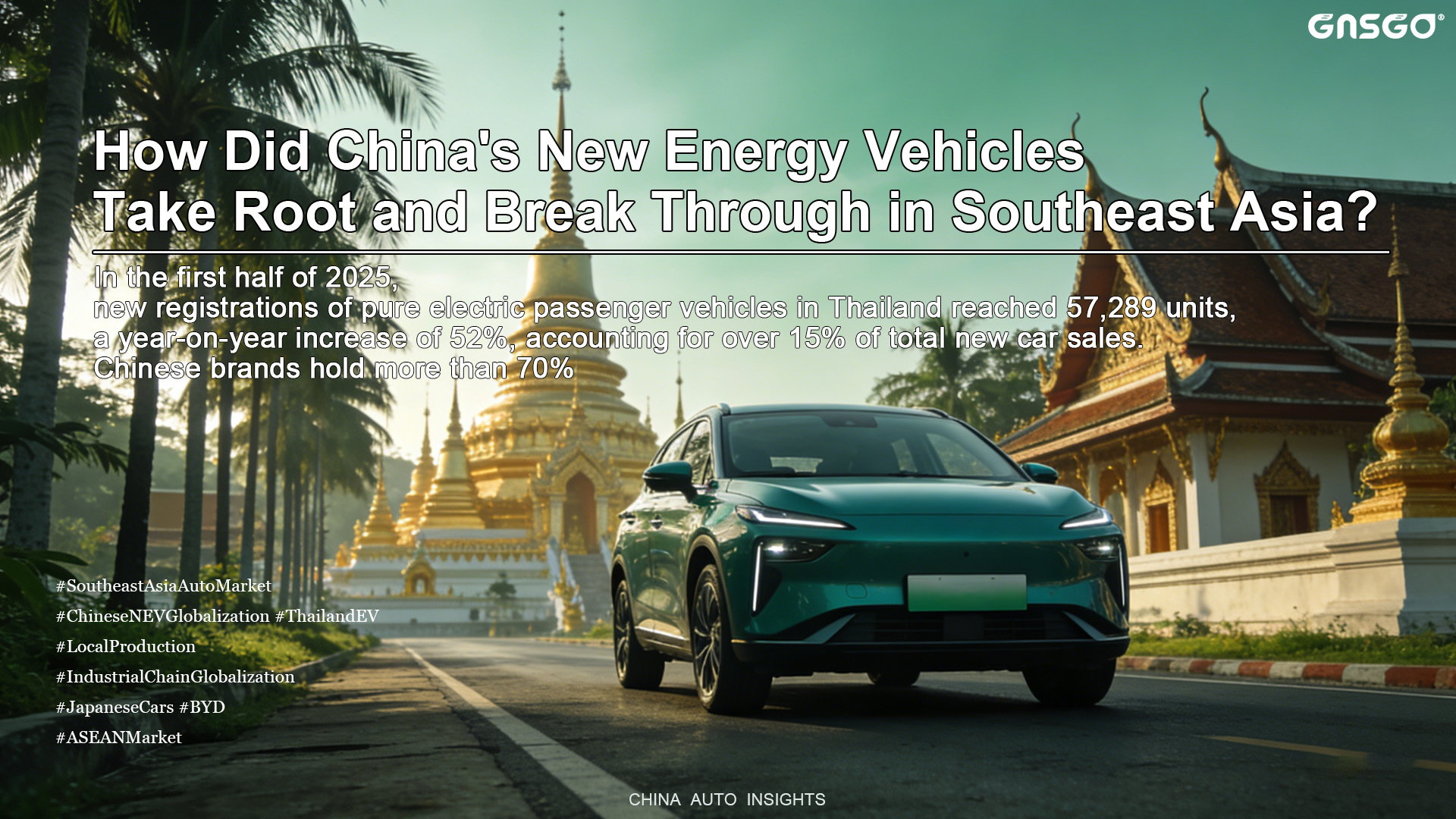
In the first half of 2025, new registrations of pure electric passenger vehicles in Thailand reached 57,289 units, a year-on-year increase of 52%, accounting for over 15% of total new car sales. Chinese brands hold more than 70% of the Thai new energy vehicle market, meaning over two out of every three electric vehicles sold are Chinese.
In Thailand’s overall automotive sales ranking from January to October 2025, BYD climbed to fourth place, surpassing Honda in monthly sales for the first time in June to become the market’s second-largest brand. Brands like GAC and Changan also entered the top ten, signaling a shift from a “Japanese dominance” to a “Sino-Japanese leadership” structure.
Chinese automakers are accelerating localized production in Southeast Asia. Geely is investing in a plant in Vietnam, Changan’s Rayong plant in Thailand has commenced production, BYD’s Indonesia factory is set for completion by the end of 2025, and Xpeng has initiated a localized production project in Malaysia, signifying deep-rooted industrial chain integration.
In-Depth Analysis
Chinese brands attracted users with the “high-spec, low-price” of the EVs themselves. As competition intensifies, the key differentiator has shifted to the competitiveness of the entory vehicle usage ecosystem. This includes: building local battery supply chains with partners like CATL to ensure cost and supply; localizing intelligent cockpit and driving assistance features to enhance experience; and most crucially—building reliable after-sales service networks to establish long-term trust. The dimension of competition has expanded from a single product to a comprehensive value system of “product + supply chain + service + brand.” Cases where some brands faced overseas service disruptions due to domestic setbacks (e.g., Neta) conversely highlight the importance of systemic capability.
Industry Insights
The future of emerging markets belongs to “National Strategy Co-builders.” The smooth progress of Chinese brands in Southeast Asia is fundamentally due to the alignment of their business with host countries’ national-level industrial transformation strategies, such as Thailand’s “Eastern Economic Corridor” and Indonesia’s “Battery Industry Chain Ambition.” Future globalization requires companies to be not just commercial entities but also “empowerment partners” and “solution providers” that help host countries achieve their strategic goals.
The ultimate battleground for brand building is “Cultural Identity” and “Trust Accumulation.” Chinese brands still need time to prove themselves in areas like durability and resale value. To transcend the “cost-performance” label, brand narratives must integrate an understanding of local culture and values (e.g., communication focused on family travel, pragmatic spirit). Moreover, reliable products and exceptional service over decades are needed to accumulate the kind of “unconscious trust” enjoyed by Japanese brands. This is the most difficult yet crucial leap from “Made in China” to “China Brand.”
SoutheastAsiaAutoMarket ChineseNEVGlobalization ThailandEV LocalProduction IndustrialChainGlobalization JapaneseCars BYD ASEANMarket