China's Middle East Exports Reach 1.21 Million
Core Data/Events
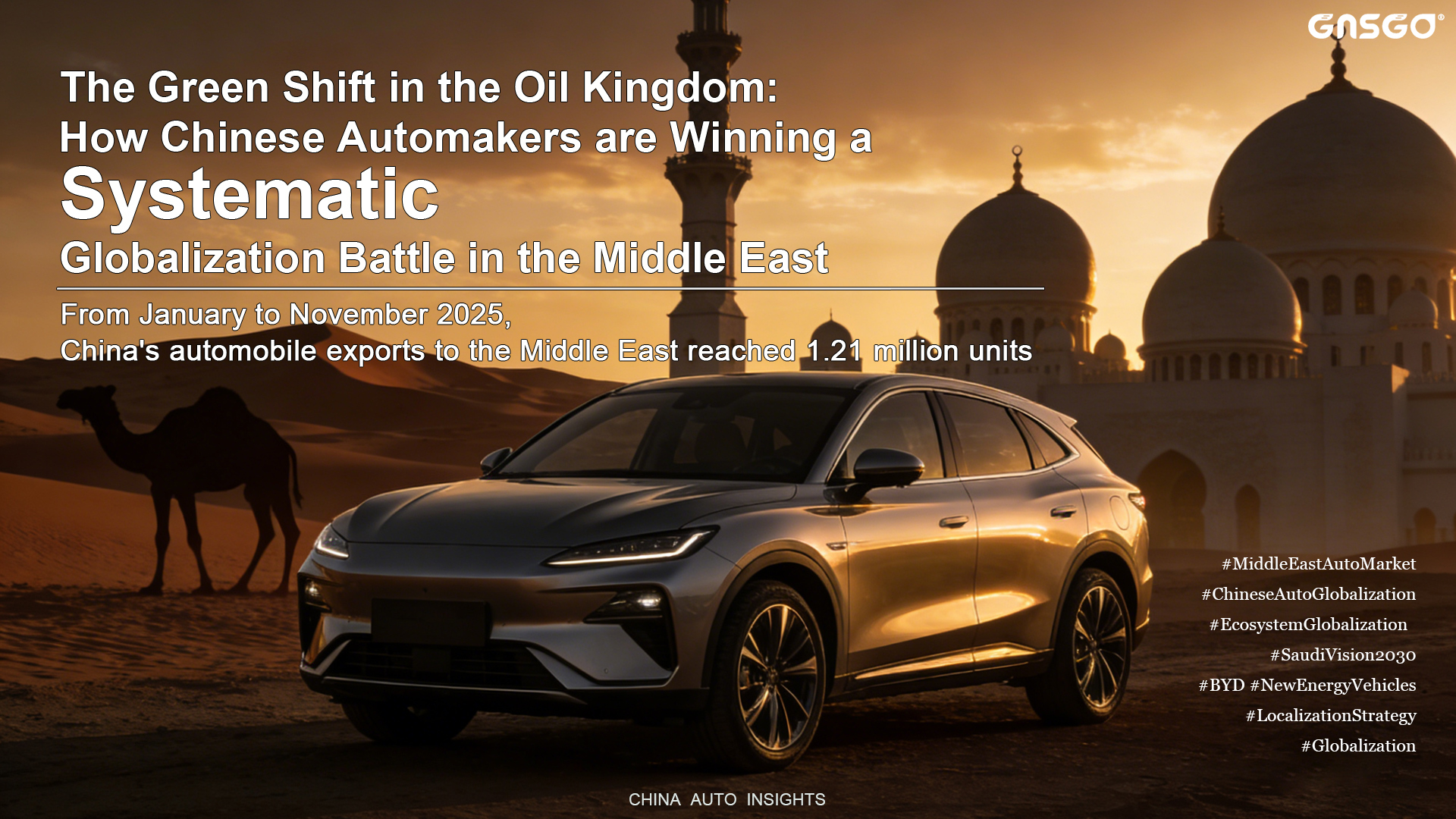
From January to November 2025, China’s automobile exports to the Middle East reached 1.21 million units, a year-on-year increase of 36%, raising its market share to 17%. The UAE (465,500 units, +78%) and Saudi Arabia (265,800 units, +23%) were the third and eighth largest export markets for Chinese vehicles, respectively.
BYD’s sales in the Middle East reached 35,000 units in the first half of 2025, a 120% year-on-year increase, capturing a 19% market share in Saudi Arabia. Geely’s market share in the Middle East surged from 1.3% in 2018 to over 15% in 2024.
Under its “Vision 2030,” Saudi Arabia plans to invest $39 billion to build an EV ecosystem, aiming for 30% EV penetration in Riyadh. The UAE targets 50% of road vehicles to be electric by 2050, with its NEV penetration rate exceeding 25% in 2024, the highest in the Middle East.
In-Depth Analysis
Facing Tesla’s technological aura and the brand fortresses of Japanese and German brands, Chinese automakers have not fallen into “cost-performance” involution. They wisely chose “dimensional competition”: BYD builds a three-dimensional matrix of “product + channel + ecosystem” with its DM-i/p technology and the upcoming premium brand “Yangwang,” directly targeting the minds of high-end users. Geely collaborates with Qatar on high-temperature-resistant battery R&D for deep technical adaptation. Chery offers precise customization for the Middle East’s preferred “boxy” design. This competition tests the ability to engineer solutions for extreme climates, “translate” products for local culture, and define brands in the premium market.
The most profound change is the iteration of the globalization model. Chinese automakers are transforming from “outsiders” in the Middle East market into “local value creators.” This is reflected in: Production localization (e.g., BYD’s planned plant in Turkey); R&D localization (Geely’s battery cooperation for high temperatures); Service localization (NIO building battery swap stations, Chery partnering with JD.com for parts warehouses); and even “Ecosystem localization” (automakers deeplyparticipate local charging networks and energy transition). The goal is to generate an industrial value network within the Middle East market that integrates R&D, production, sales, service, and infrastructure, possessing self-evolutionary capabilities.
Industry Insights
The Core of Globalization 2.0 is Becoming a Co-builder of the Host Country’s “National Strategy.” Future globalization requires deeply binding corporate strategy with the national transformation agenda of target markets. The fundamental success of Chinese automakers in the Middle East lies in positioning themselves as implementation partners and capability providers for Saudi Arabia’s “Vision 2030” and the UAE’s “2050 Strategy,” thereby gaining wider policy acceptance and development space. Technological Advantages Must Undergo “Scenario-Based Tempering” to Transform into Market Advantages. Chinese technology in areas like three-electric systems and intelligent driving only becomes a globally recognized reliability badge after passing the extreme environmental verification of the Middle East’s 70°C+ heat and pervasive sand dust. Thus, the Middle East becomes the best “pressure test field” and “quality endorser” for Chinese automotive technology, providing an indisputable credential for its entry into more demanding global markets. “System Globalization” Has Far Greater Risk Resilience Than “Product Globalization.” While trade barriers may sever product flow, deeply rooted local R&D, manufacturing, supply chain, and service networks maintain resilience. The value network built in the Middle East serves not only the local market but can also become a regional hub radiating to Europe and Africa. This “systemic strength,” based on deep localization, is the most stable ballast for Chinese automobiles against global uncertainties.
MiddleEastAutoMarket ChineseAutoGlobalization EcosystemGlobalization SaudiVision2030 BYD NewEnergyVehicles LocalizationStrategy Globalization