China's Electric Pickups: 7.3% and Going Global
Core Data/Events
-
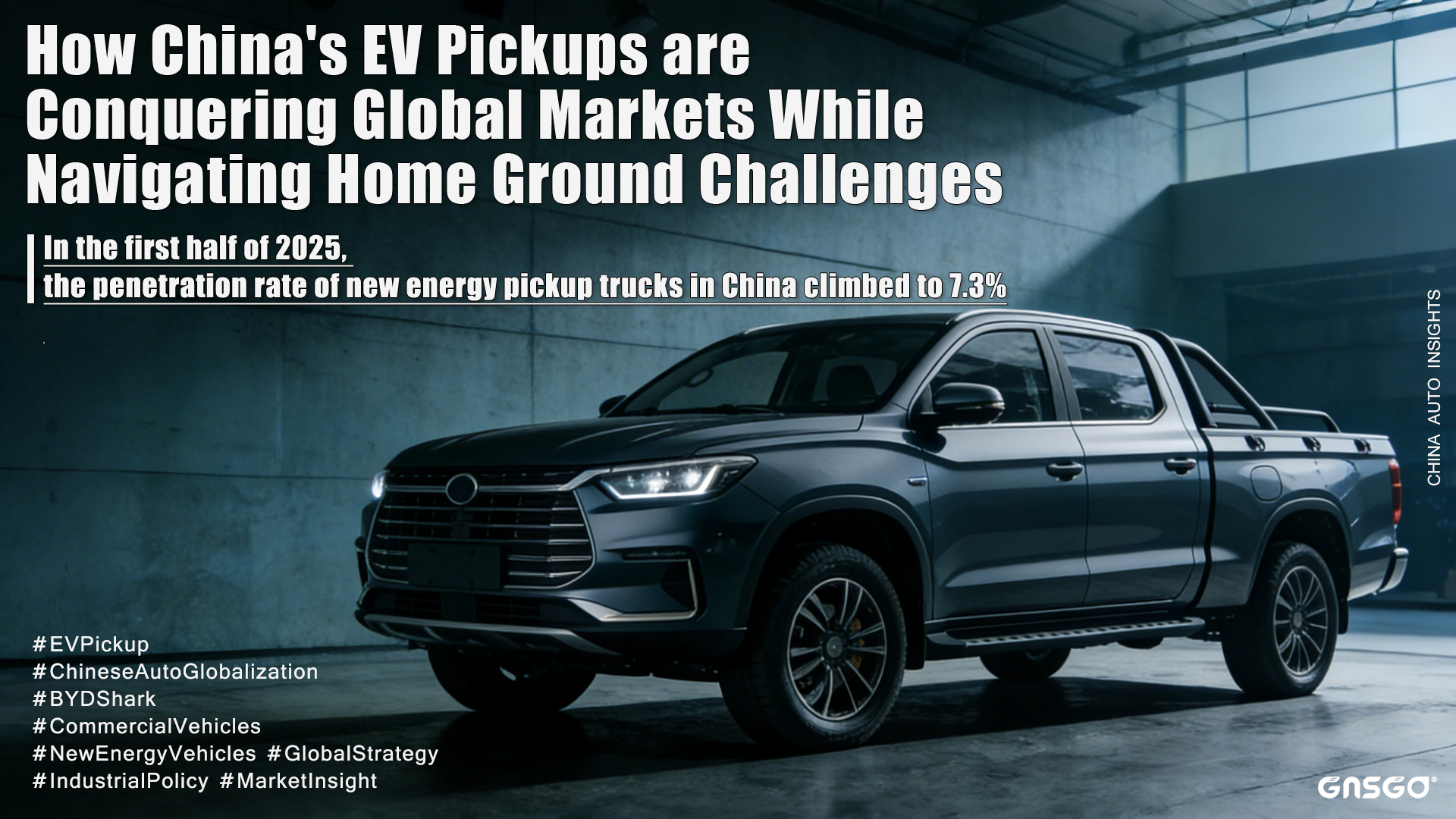
In the first half of 2025, the penetration rate of new energy pickup trucks in China climbed to 7.3%. Among them, Geely Radar commanded a dominant market share of 54.7%, reflecting a highly concentrated landscape.
-
Since its global launch, the BYD SHARK (Shark) pickup has achieved cumulative exports of over 40,000 units, competing head-on with Toyota and Ford in markets like Australia and Mexico and ranking among sales leaders. Yet, this star model manufactured in China remains unavailable in its home market.
-
In China, pickups are still classified as “light trucks,” subject to constraints like a 15-year mandatory scrappage policy and driving restrictions in some cities. However, a trend towards lifting these bans is also underway, injecting new growth potential.
-
In Southeast Asia and Latin America: The strategy is “commercial value-for-money” and “energy adaptability.” For example, the BYD Shark meets long-distance agricultural transport needs with over 800km combined range; Great Wall offers plug-in hybrids compatible with local ethanol fuel in Brazil. This precisely targets the pain points of Japanese fuel-powered models under high oil prices.
-
In Australia/New Zealand and Europe: The focus is on “technology democratization” and “lifestyle.” The Great Wall Shanhai Pao Hi4-T won awards in Australia with its hardcore “triple lock” off-road capability and luxurious cabin comfort; the BYD Shark builds a smart and premium image with its 5.7-second acceleration and vehicle-to-load (V2L) functionality. This avoids direct confrontation with Ford and Toyota on traditional pickup culture, creating a new niche.
Industry Insights
-
Domestic automakers need a “dual-track strategy” to address market segmentation. One track involves deepening the commercial market by consolidating government and corporate clients through customized services and cost control. The other track focuses on the personal use market, creating “lifestyle vehicles” with new energy and intelligent technology, while actively advocating for policies that ease driving restrictions on pickups.
-
“Going global” is the ultimate test for product strength and business models. The intense competition in mature overseas pickup markets quickly validates product reliability, technological advancement, and brand positioning. The success of brands like BYD and Great Wall demonstrates that refining a product overseas before “repatriating” it to the domestic market is a path with lower risk and stronger brand momentum.
EVPickup ChineseAutoGlobalization BYDShark CommercialVehicles NewEnergyVehicles GlobalStrategy IndustrialPolicy MarketInsight