Chery and BYD Push China's Exports Past 2.4 Million
Core Data/Events
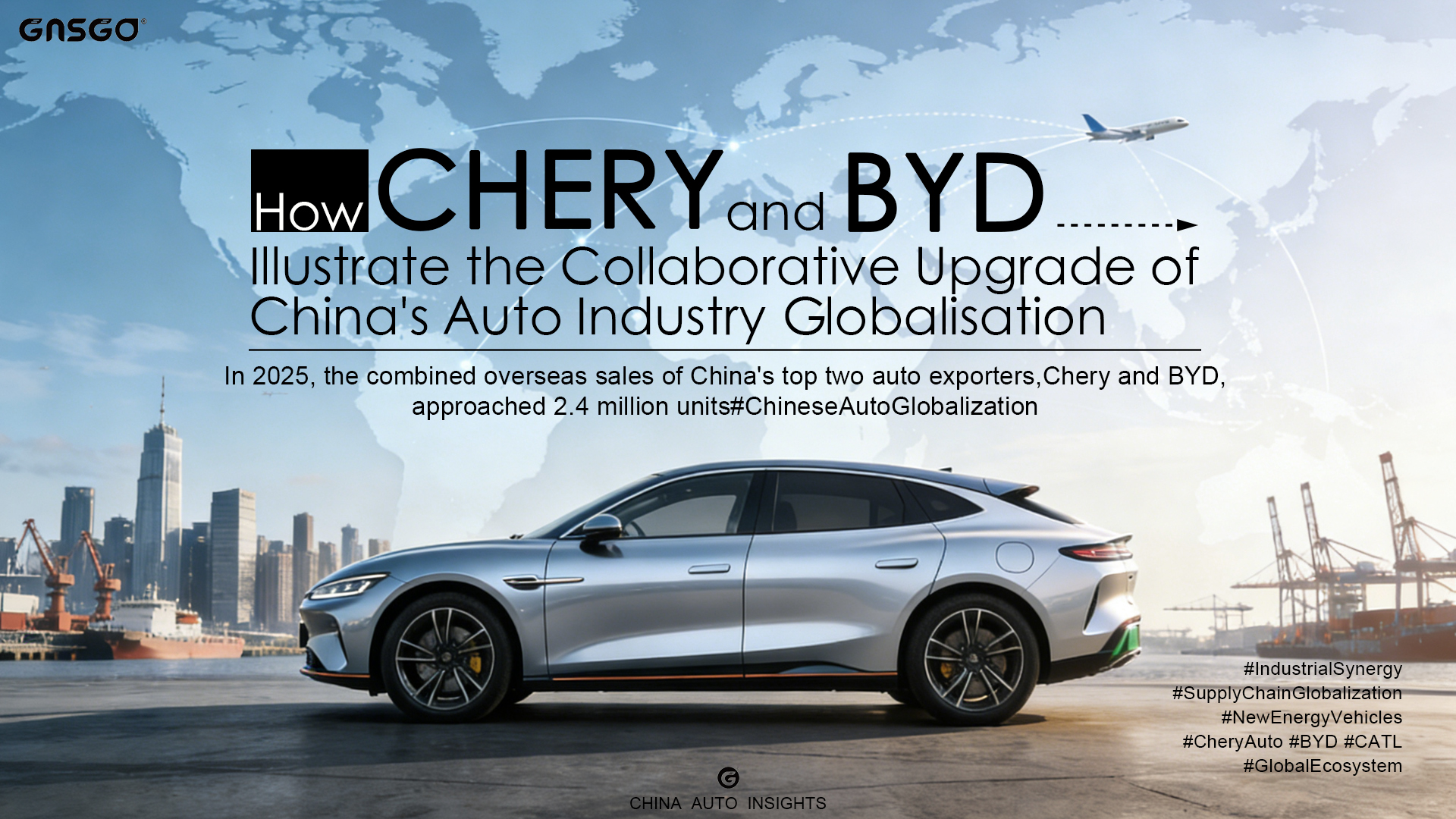
Scale Milestone: In 2025, the combined overseas sales of China’s top two auto exporters, Chery and BYD, approached 2.4 million units, constituting a significant portion of China’s total vehicle exports. This signifies that China’s auto globalization has progressed from individual corporate exploration to a new phase driven by synergistic industrial giants.
Coexisting Paradigms: Chery has spent 25 years building a global ecosystem spanning over 120 countries with 16 factories; BYD leveraged its NEV technological edge to achieve exponential overseas growth from 56,000 units (2022) to 1.05 million units (2025) in just 3 years. The simultaneous success of both models demonstrates that the Chinese automotive industry now possesses diversified global expansion capabilities.
Supply Chain Globalization: Represented by CATL, China’s core component suppliers are globalizing in tandem. Its “Ningjia Service” established a major NEV aftermarket hub in Saudi Arabia and operates over 1,200 service points across 76 countries, building a critical “infrastructure layer” for Chinese vehicle exports.
In-Depth Analysis
The “Dual Paradigm” of Industrial Capability: Complementarity of Depth and Speed
The overseas journeys of Chery and BYD do not represent a simple rivalry but together outline the complete spectrum of the Chinese automotive industry’s capabilities. Chery’s “deep dive” validates the long-term viability and immense value of trinity localization integrating “brand, channels, and manufacturing” in complex international markets. Its global KD/SKD assembly network is itself a form of flexible export of supply chain and technical standards. BYD’s “blitzkrieg” model proves that with clear generational technological advantages (electrification) and vertically integrated supply chain efficiency, new markets can be rapidly opened and new rules established. Both capabilities are indispensable for the collective global expansion of China’s auto industry: the former provides a stable foundation, the latter acts as a growth engine.
Towards a Global Ecosystem: The Chinese Auto Industry’s New Role as “System Integrator”
Today, China’s automotive industry is assuming a new role globally: the “system integrator” and “rule contributor” for the smart electric vehicle era’s ecosystem. This is manifested in three aspects:
Export of Technical Standards: From BYD’s CTB battery-integrated chassis and Yi Si Fang platform to NIO’s battery swap standards, Chinese companies are exporting not just products but new technological architectures and solutions.
Innovation in Cooperation Models: Chery’s revival of the local “EBRO” brand in Spain and its cooperative production via the “Tenet” brand in Russia demonstrate a flexible “technology equity, brand co-creation” partnership model. This resonates with Baidu Apollo’s deployment of Robotaxi in the UAE through a “tech + local operations” model, both representing a more advanced form of industrial value export.
Global Resource Orchestration: Chinese automakers are globally configuring R&D (Chery’s “1+7+N” global R&D network), design, supply chain, and talent resources. BYD’s hiring of local engineers for its Hungary factory aims to deeply integrate into and lead the local industrial ecosystem. The ultimate goal of globalization is to transform from “the world’s factory of China” into “Chinese automakers for the world.”
Industry Insights
The Core Competitiveness of Chinese Auto Exports Has Evolved from “Individual Product Advantage” to “Industrial Cluster Synergy Advantage.” Future global competition will be “fleet warfare,” characterized by leading OEMs spearheading the collective overseas expansion of core components, service systems, and digital solutions. The success of any single company will increasingly depend on the depth and Collaboration efficiency of the entire Chinese automotive industry ecosystem worldwide.
The Globalization of the Supply Chain is a “Mandatory Question,” and Its Form Determines Export Quality. Supply chain globalization is no longer limited to building factories but involves forming a multi-tiered structure of “core component bases (e.g., batteries) + regional OEM clusters + aftermarket service networks.” Establishing independent service ecosystems like CATL or building industrial parks with supply chain partners like Chery and BYD are key to enhancing the global system resilience and comprehensive cost competitiveness of Chinese automobiles.
The Chinese Auto Industry is Achieving a “Perilous Leap” in the Global Automotive Value Chain: From Scale Contributor to Innovator and Ecosystem Definer. We are not only exporting highly competitive automotive products but also new technological pathways, business models, and cooperation paradigms. This requires the entire industry to possess grander narrative capabilities, transforming technological and manufacturing advantages into sustainable brand value and industrial leadership.
ChineseAutoGlobalization IndustrialSynergy SupplyChainGlobalization NewEnergyVehicles CheryAuto BYD CATL GlobalEcosystem