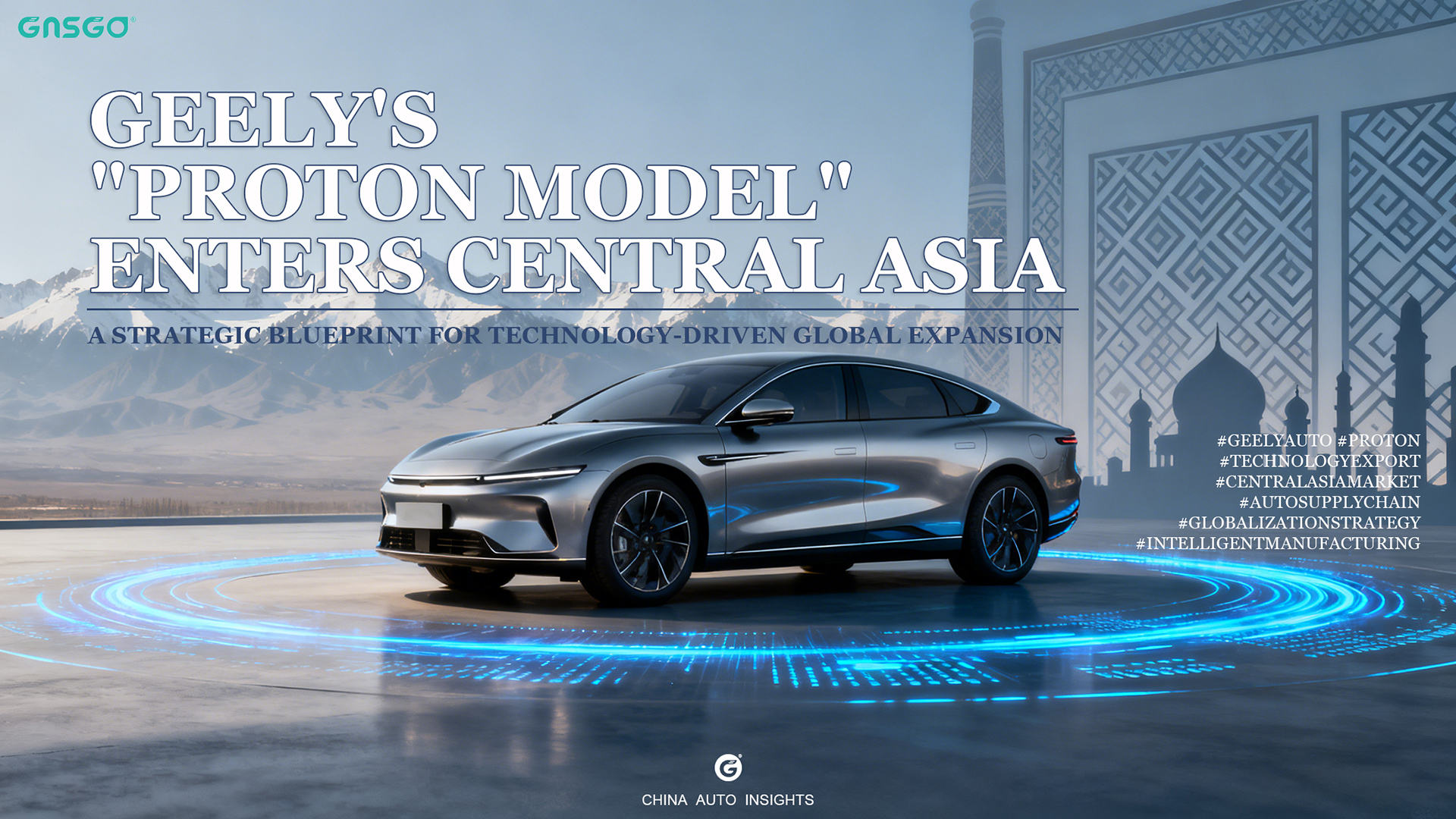
Geely's Proton Brand Model Enters Central Asia
Core Data/Events
-
Accelerated Strategic Layout: Geely’s PROTON brand recently signed MoUs with both Kazakhstan and Uzbekistan, marking its systematic entry into Central Asia via a “technology licensing + localized production” model.
-
Proven Market Success: Since Geely’s strategic investment and 49.9% acquisition in 2017, PROTON’s market share in Malaysia rebounded from a low of 12% to over 20%, achieving profitability and validating Geely’s brand revitalization and supply chain capabilities.
-
Regional Market Potential: The five Central Asian countries have a total annual vehicle market of approximately 500,000 units, with Kazakhstan (~150,000 units) and Uzbekistan (~300,000 units) as the core markets, where BYD and Chery have already established KD assembly presence.
In-Depth Analysis
-
Brand Advantage: As Malaysia’s “national treasure” brand, PROTON carries Commonwealth technological heritage and a “Muslim-friendly” image, providing inherent cultural affinity and political acceptability in Central Asia and broader Islamic markets compared to a direct Chinese brand entry.
-
Validated Model: This move continues the logic of Geely’s collaborations with Renault in South Korea and Brazil, leveraging technology export and light-asset operation for rapid regional market entry while avoiding high tariffs and geopolitical risks.
-
Full Value-Chain Capability: The cooperation extends beyond CKD assembly to include technology transfer and supply chain management, aiming to help partner countries build modern automotive industries for mutual benefit.
Industry Insights
-
Geely’s “PROTON Model” offers a second path for globalization: “asset-light, high-value-added.” When direct brand entry faces obstacles, utilizing strategically invested local brands or technology licensing partnerships enables “indirect market entry” and gradual regional influence building.
-
Focus on the transition of Chinese automakers from “product trade” to “export of technology standards & business models.” Companies with strong platform technologies, supply chain management, and international partnership experience will have higher valuation ceilings.
-
Partnering with established Chinese automakers is an efficient path to rapidly build a domestic auto industry and integrate into the global supply chain. However, balancing the long-term goals of “trading market for technology” and “cultivating indigenous competitiveness” is crucial.
Do you believe “technology export” rather than “product export” will become a mainstream model for the future internationalization of Chinese automakers?
GeelyAuto PROTON TechnologyExport CentralAsiaMarket AutoSupplyChain GlobalizationStrategy IntelligentManufacturing