GAC and Allur Group Start Production in Kazakhstan
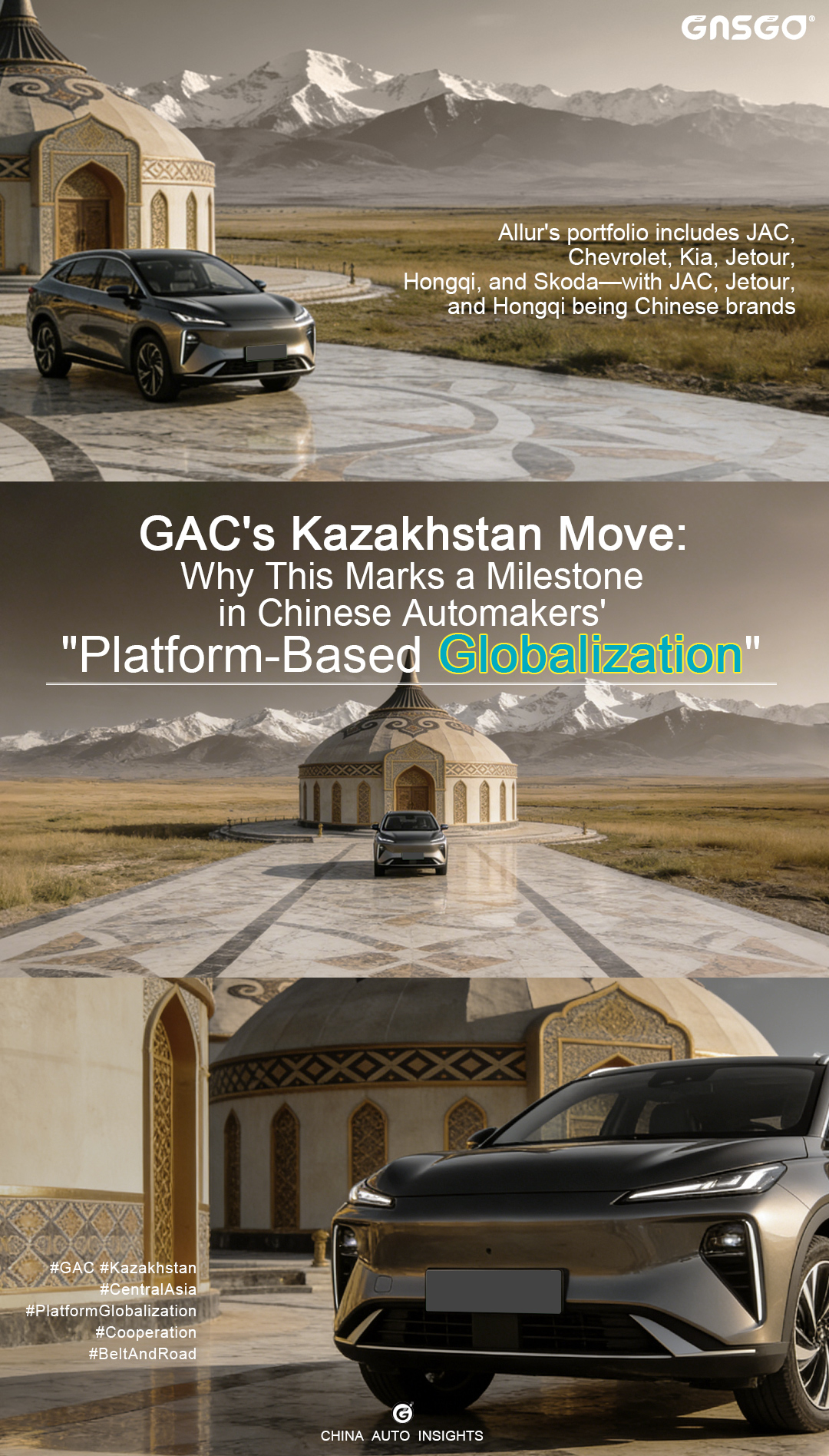
Core Data/Events On February 17, GAC International signed an industrial cooperation agreement with Kazakhstan’s Allur Group, enabling phased local production of GAC vehicles covering certification, regulatory compliance, and local market adaptation. ● Who is Allur: Kazakhstan’s only automaker with full CKD capabilities, boasting annual capacity of 127,000 units, producing over 60% of the country’s vehicles, with market share consistently above 40% . In late 2019, Genertec + JAC acquired 51% of Allur, creating a “template project” for China-Kazakhstan production capacity cooperation. ● Chinese DNA: Allur’s portfolio includes JAC, Chevrolet, Kia, Jetour, Hongqi, and Skoda—with JAC, Jetour, and Hongqi being Chinese brands. In 2025, Chinese brands captured 39% of Kazakhstan’s market . ● Market Potential: Kazakhstan’s 2025 new vehicle sales hit 234,852 units, up 14.4% YoY, exceeding 200,000 for the second consecutive year . China exported 211,545 vehicles to Kazakhstan in 2025 .
In-Depth Analysis The GAC-Allur deal is more than adding another OEM brand—it marks the strategic upgrade of China-Kazakhstan production capacity cooperation from a “template project” to a “platform-based operation.” Three layers deserve attention:
From “One-to-One” to “One-to-Many”: Allur’s Platform Transformation
Allur’s initial partnership with JAC was a classic “one-to-one”production capacity template—one Chinese brand tied to one local plant. Bringing in GAC signals Allur’s official transformation into a “Chinese Auto Manufacturing Platform for Central Asia.” The implication: later-mover Chinese brands (like GAC) can leverage mature platforms without rebuilding production capacity, slashing entry barriers and trial costs.
For controlling shareholders Genertec and JAC, short-term competition with JAC aside, platform value trumps single-brand value—the more open Allur becomes, the more entrenched its status as Central Asia’s production capacity hub, and the higher its asset value.
Geopolitical Chess: Kazakhstan’s “Manufacturing Hub” Ambition
Kazakhstan isn’t just Central Asia’s largest auto market—it’s a EAEU member. Vehicles locally produced at Allur enjoy tariff-free access to Russia, Belarus, Armenia, and Kyrgyzstan, covering a 180-million-person market.
While China’s Russia exports declined geopolitically in 2025, Kazakhstan exports remained resilient . The “Chinese parts + Kazakhstan assembly + EAEU sales” model helps Chinese automakers diversify risk and build regional industrial chain collaboration.
Localization’s “Forcing Mechanism”
In 2025, all top-10 best-selling models in Kazakhstan were locally produced. Pure trade has hit a ceiling—growth now demands localization.
Allur’s 127,000-unit annual capacity currently covers over 50% of domestic demand . With Chinese brands already at 39% market share, localization is shifting from “optional” to “mandatory.” GAC’s timing is strategic.
Industry Insights GAC’s Kazakhstan move offers three lessons for Chinese automakers going global:
“Platform-Based Globalization” Beats “Going Solo”: Duplicative production capacity builds overseas waste resources. Platforms like Allur—Chinese-controlled, multi-brand,mature—should serve as “fast lanes” for Chinese brands entering regional markets. Later-movers should “board the boat” rather than build their own.
Localized Production Is Market Share’s “Moat”: All top-10 models locally produced in Kazakhstan 2025 sends a clear signal: when localization becomes table stakes, pure-trade players get pushed out. Chinese brands’ 39% share must be defended with local manufacturing.
EAEU Is the “Hidden Dividend”: Kazakhstan’s EAEU membership makes it a “back door” to Russia and neighbors. Amid geopolitical uncertainty, this “regional springboard” is being revalued.
GAC Kazakhstan CentralAsia PlatformGlobalization BeltAndRoad