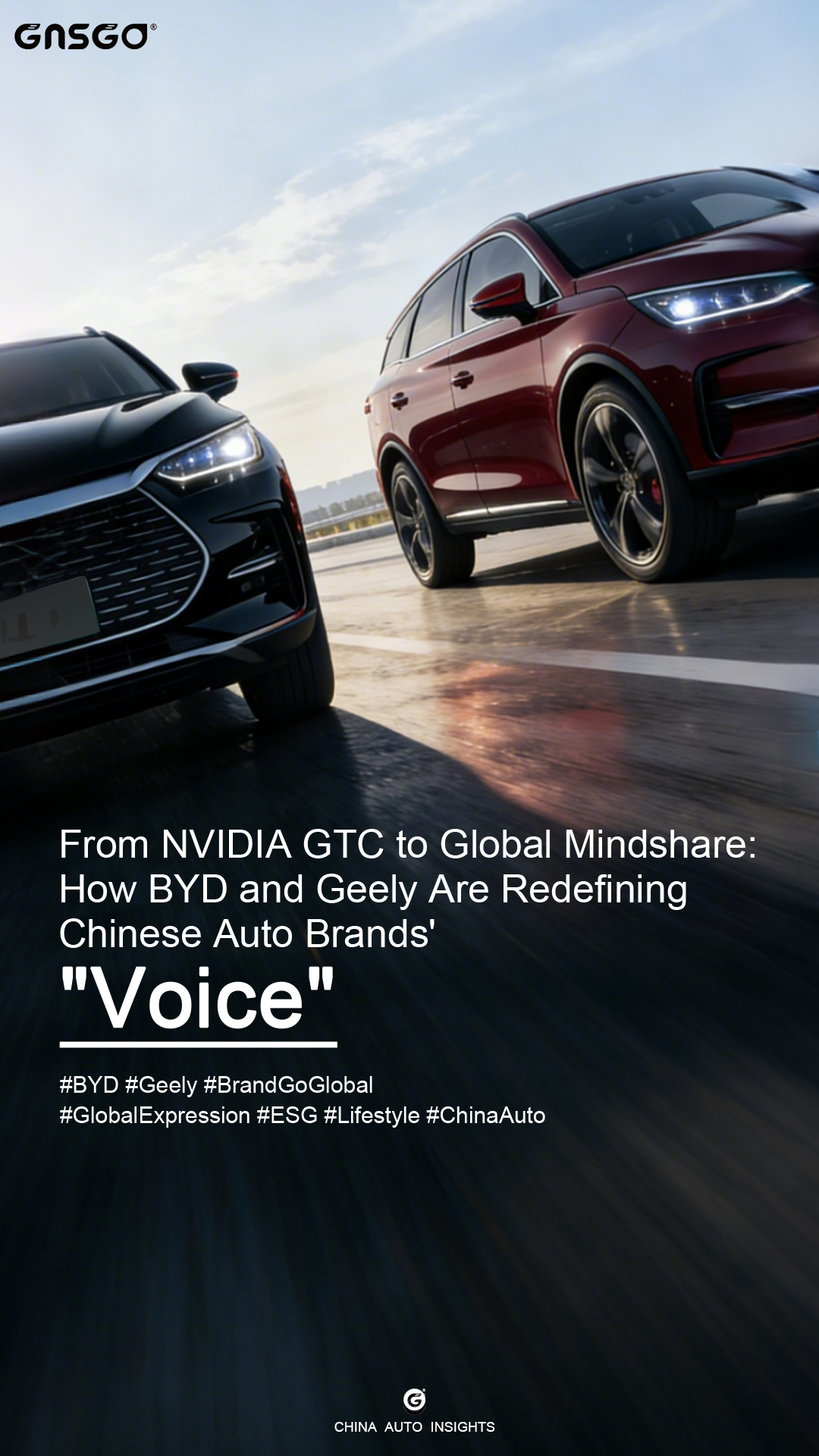
NVIDIA GTC 2026: BYD and Geely Join the Autonomy Race
Core Data/Events
Dimension Key Information
Tech Partnership At NVIDIA GTC 2026, NVIDIA announced autonomous driving development partnerships with five automakers—Hyundai, Nissan, Isuzu, and Chinese automakers BYD and Geely. Chinese brands secured two seats, marking their entry into the core of global technology narratives and industrial collaboration
Cooperation Scope Centered around NVIDIA’s “Drive Hyperion” autonomous driving platform, which enables companies to develop and deploy L4-level assisted and autonomous driving capabilities—full driverless operation within preset areas or conditions without human intervention
BYD Strategy Building a “dual-layer expression structure”: Values layer—translating ESG into high-frequency, reusable content (carbonemissions, greenmobility have become core semantic units alongside brand terms); Experience layer—using highly visual content like the YANGWANG U9 autonomous flight to create intuitive impressions of “future mobility”
Geely Strategy Emphasizing “local context + lifestyle” adaptation: during cultural moments like Chinese New Year and World Cycling Day, using internationally-adapted Eastern elements for cultural communication;around “roof-mounted bikes,” “outdoor exploration” scenarios, integrating product features into lifestyle contexts like camping, travel, and sports
Expression Logic Shift Focus has shifted from “bridging awareness” (do users know you) to “reinforcing choice” (why users consistently choose you)
In-Depth Analysis 1. BYD: Rebuilding Global Cognitive Anchors Through “Values + Experience” BYD’s global brand expression has formed a complete “dual-layer structure”: one layer is value expression, the other is experience and imagination construction. Values Layer: Making ESG Perceptible and Communicable As an NEV brand, BYD has natural advantages in topics like emission reduction and green mobility. In overseas communications, this advantage hasn’t been handled as abstract corporate responsibility narratives, but transformed into high-frequency, reusable content expression. Observing its global Facebook page, carbonemissions and greenmobility have become core semantic units appearing alongside brand terms. This means ESG is no longer just report information but has entered daily content flow as “default narrative.” The key to this approach is that it lowers the threshold for global users to understand brand value—without reading complex corporate disclosures, users can form a stable perception of “a brand highly relevant to sustainability” through continuous information exposure. Experience Layer: Building Aspiration Through “Future Sense” Values alone are insufficient. BYD’s second layer of expression is constructing “future experience.” Among its high-engagement content, the most representative case is around the YANGWANG U9—one of the most interacted posts in the past 90 days on its social media homepage featured “YANGWANG U9 autonomous flight at 74.5 mph, soaring 6 meters.” The focus of such content isn’t explaining specific technical paths, but directly establishing users’ intuitive sense of future mobility through highly visual, nearly “paradigm-breaking” moments. In other words, it’s not “selling cars” but letting users “see the future” in concrete ways. After these two layers overlay a more compelling brand structure emerges: on one hand, establishing “rightness” through ESG and green narratives; on the other, building “aspiration” through cutting-edge technology expression. The result is that users no longer see just an NEV brand, but a brand entrance connecting both “responsibility” and “future lifestyle.” Purchase behavior, therefore, is no longer just functional choice but carries obvious identity and value alignment attributes. 2. Geely: Achieving Expression Adaptation Through “Local Context + Lifestyle” If BYD emphasizes “unified and stable value expression,” Geely’s path leans toward another capability: naturally integrating the brand into different cultural contexts. The core of this capability lies not in the information itself, but in the “embeddedness” of expression. Cultural Touchpoints: Eastern Elements for Global Stories From its overseas content strategy, Geely doesn’t obsess over continuously outputting standardized product information. Instead, it chooses to build brand-user connections through festivals and specific life scenarios. For example, during cultural moments like Chinese New Year, Geely uses content with Eastern elements but internationally adapted expression for cultural communication. During global moments like World Cycling Day, it around specific use scenarios like “roof-mounted bikes” and “outdoor exploration” to build more participatory lifestyle narratives. Lifestyle: From “Car” to “People” The key to this strategy is shifting the starting point of “automotive content”—no longer starting from “the car,” but from “how people live.” When content core shifts from products to lifestyle, products themselves become more easily accepted: roof-mounted bikes, in-car entertainment systems—these originally disperse functional points are reorganized into specific contexts like camping, travel, sports, becoming parts of a complete experience. More importantly, this expression approach naturally cross culturally adapts. Whether in Europe or Southeast Asia, users’ understanding of outdoor, exploration, and family travel is universal. Brands only need minor adjustments in specific details to achieve localized content land. What Geely has accomplished, therefore, is not simple content localization, but a higher-level capability: using user-familiar contexts to carry the same brand logic across different markets.
Industry Insights
“Values” Are Assets That Can Be Communicated: ESG isn’t just a slogan in annual reports—it can be transformed into high-frequency, reusable brand assets. BYD making greenmobility a core semantic unit alongside its brand name is essentially building a brand perception that users understand without explanation.
“Local Context” Is the Passport for Cross-Cultural Communication: Geely doesn’t use “Chinese brand” as its primary tag. Instead, through internationally adapted Eastern elements and universally understood lifestyle scenarios, it enables the brand to naturally integrate into different cultures. This “embeddedness” is far more persuasive than any standardized information output.
BYD Geely NVIDIA DriveHyperion L4AutonomousDriving BrandGoGlobal GlobalExpression