China-Canada Deal Cuts EV Tariffs to 6.1%
Core Data/Events
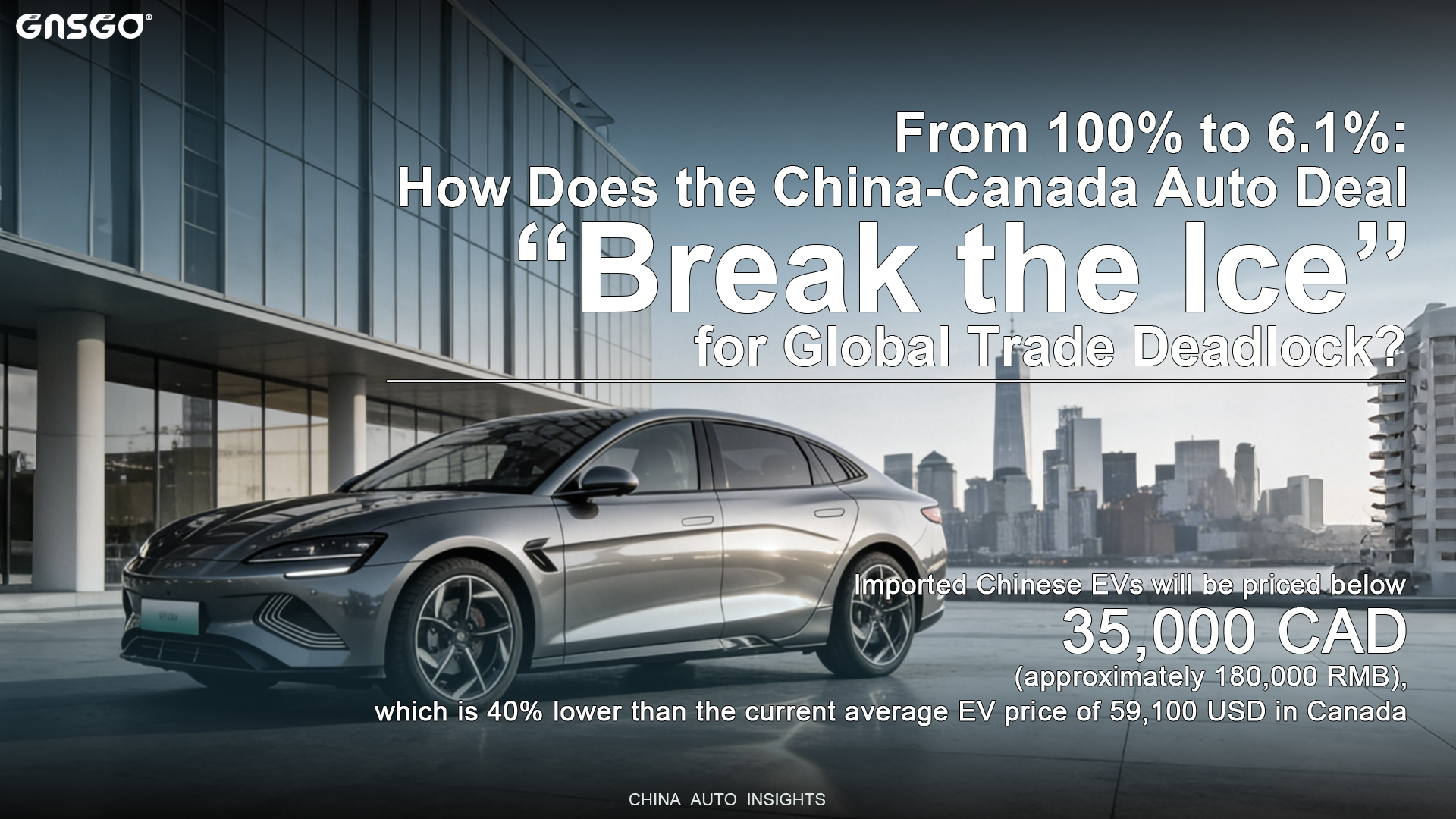
On January 16, 2026, during his visit to China, Canadian Prime Minister Carney announced the removal of the 100% additional tariff imposed on Chinese electric vehicles since 2024. It was replaced with an annual import quota of 49,000 vehicles, subject only to a 6.1% Most-Favored-Nation tariff within the quota, with the quota set to increase annually.
The agreement stipulates that over half of the imported Chinese EVs will be priced below 35,000 CAD (approximately 180,000 RMB), which is 40% lower than the current average EV price of 59,100 USD in Canada. This quota accounts for about 3% of the Canadian new car market, directly addressing the 110,000-unit EV market gap in 2026 due to industrial shortcomings.
In-Depth Analysis The “Paradigm Upgrade” of Chinese Auto Globalization: From Product Trade to Ecosystem Export For the Chinese automotive industry, breaking into the Canadian market holds strategic value far exceeding the short-term sales of 49,000 units. It signifies that the globalization of Chinese new energy vehicles has entered “Phase 2.0.”
The Symbolic Significance of Market Access: Obtaining “official access” to the Canadian market signifies that the technical standards of Chinese EVs in safety and environmental protection have gained recognition within the North American system. This is a crucial endorsement of Chinese automotive brand value in a premium global market.
A New Paradigm of Ecosystem Export: The agreement concerns not only products but also the vision of “supply chain collaboration” and “future localized production”. This indicates that the capability China’s auto industry is exporting is upgrading from single “cost-effective products” to a “comprehensive industrial ecosystem solution” encompassing “vehicle manufacturing, three-electric technology, supply chain management, and energy replenishment systems.” This logic aligns seamlessly with recent layouts by Chinese automakers in regions like the Middle East and Latin America. As industry observations predict, China’s auto globalization is accelerating the push on of an “ecosystem synergy model integrating vehicles, intelligence, batteries, components, and services”
Industry Insights
The Core of Global Auto Industry Competition is Shifting from “Single Product Power” to “Full Industrial Chain Influence.” China’s advantage is no longer just about 30-40% lower battery costs but the comprehensive ability to organize a complete industrial ecosystem from minerals and materials to components, vehicles, and services. In the future, the entities and countries capable of exporting and integrating this ecosystem will define the new rules.
China’s Auto Industry Must Utilize the Window of Opportunity to Complete the Transformation from “Market Pioneer” to “Standard Co-builder.” Upon entering markets like Canada, the real challenges lie in brand recognition, cultural integration, and long-term service. Automakers should transcend short-term export thinking and leverage cooperation frameworks to actively participate in local supply chain cultivation, joint development of technical standards, and after-sales service network construction. This transforms the temporary “tariff advantage” into a lasting “system advantage.”
ChinaCanadaTrade EVGlobalization Globalization TradePolicy CarbonNeutral SupplyChain BYD IndustrialUpgrade