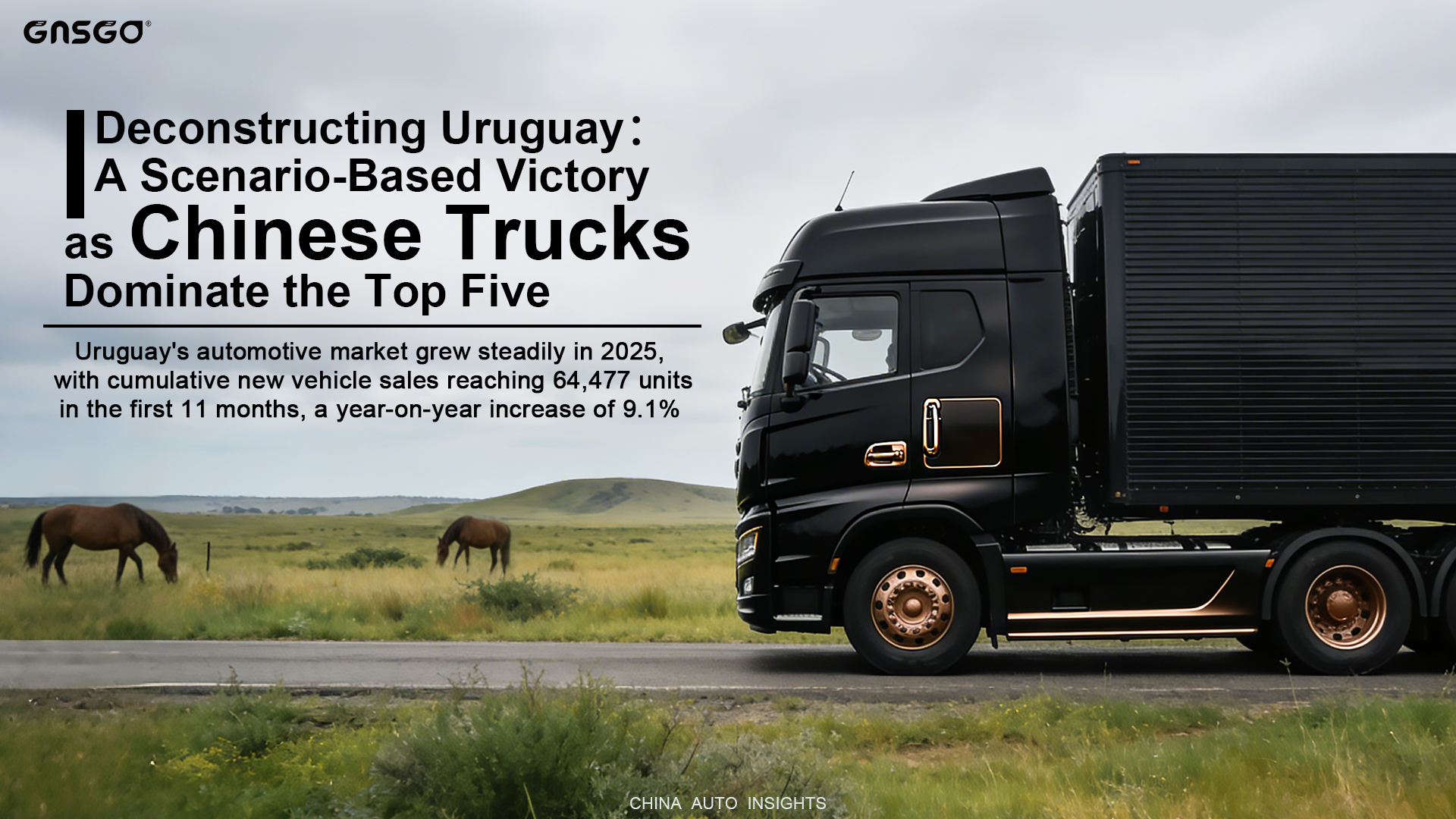
Uruguay: Chinese Trucks Take Four of the Top Five
Core Data/Events
Market Landscape: From January to October 2025, Chinese brands occupied four of the top five spots in Uruguay’s truck sales rankings, demonstrating overwhelming dominance. JAC led with 417 units, followed closely by JMC with 396 units. Dongfeng (231 units) and Foton (210 units) ranked fourth and fifth respectively.
Competitive Dynamics: European luxury brands (Volvo, Mercedes-Benz, Scania), with a combined sales volume of approximately 420 units, focus on the high-end long-haul freight segment. Traditional international brands like Volkswagen (386 units, ranked third) and Hyundai (80 units) are facing strong pressure from Chinese competitors.
Overall Market: Uruguay’s automotive market grew steadily in 2025, with cumulative new vehicle sales reaching 64,477 units in the first 11 months, a year-on-year increase of 9.1%. Chinese brands significantly increased their overall influence, with BYD ranking second in the total sales brand rankings across all categories.
In-Depth Analysis 1. First Layer of Deconstruction: Precision Saturation Strike on “Core Scenarios”
The primary victory of Chinese brands lies in their precise grasp of the “main artery” of Uruguay’s economy. As a major exporter of agricultural and livestock products, Uruguay’s core logistics scenario involves short-to-medium-haul, light-to-medium-duty transportation from ranches/farmlands to processing plants or ports. The main products of brands like JAC and JMC are tailored precisely for this high-frequency, heavy-load, and complex road condition scenario. In contrast, European heavy trucks like Volvo and Scania are “precision instruments” designed for intercontinental long-haul linehaul logistics. Their high purchase cost, maintenance expenses, and sophisticated parts become “over-engineered” for Uruguay’s short-haul needs. Chinese brands achieved a “saturation strike” on the largest fundamental demand with pragmatic products that are “adequate, user-friendly, and durable.”
- Second Layer of Deconstruction: From “Selling Products” to “Exporting Solutions”
The advantage of Chinese brands extends beyond price to encompass a complete “total cost of ownership solution.” This includes targeted product improvements (e.g., reinforced chassis, adaptation to corrosive coastal climates), relatively lower parts prices, and shorter supply wait times. For Uruguayan small and medium-sized owners and transport companies who view trucks as production tools, a vehicle’s “total cost of ownership” and “operational availability” are far more important than brand prestige. Through localized CKD assembly, after-sales networks, and parts system development, Chinese brands are systematizing and entrenching this cost and efficiency advantage.
- Reconstruction of the Market Ecology: The Commercial Vehicle Version of “Surrounding the Cities from the Countryside”
The current landscape vividly illustrates the strategy of “surrounding the cities from the countryside.” Chinese brands have firmly secured the broadest-demand, most price-sensitive light-to-medium commercial market, establishing a solid “base area”. European luxury brands, meanwhile, are entrenched in the high-value, high-profit but limited-scale “cities” (the premium heavy-duty truck market). Traditional brands like Volkswagen, caught in the middle, face a squeeze from both above (the technological aura of European brands) and below (the price competitiveness and suitability of Chinese brands), leading to the most noticeable market share loss. This niche reconstruction means Chinese brands have not only won sales but also gained the power to define the market.
Industry Insights
The key to breakthrough in emerging markets lies in “scenario depth,” not “product breadth.” The Uruguay case proves that in countries with limited market size but unique demands, success depends not on introducing the most models but on the ability to precisely target and fulfill their most frequent, most decisive core commercial scenario like a scalpel. Preliminary data collection and scenario understanding (e.g., road conditions, load factors, operational habits) are more critical than marketing budgets.
The competitiveness formula for commercial vehicle globalization has upgraded to “Cost-Performance².” The first “performance” is product suitability for specific scenarios, and the second is the reliability of the localized service ecosystem. Multiplied together, they create a hard-to-replicate “total cost of ownership” barrier. Low price alone can no longer build long-term advantage; it must be paired with investment in CKD assembly, parts warehouses, and service networks.
The globalization of Chinese automobiles is forming a synergistic pattern of “parallel advancement in passenger and commercial vehicles, empowering both lines.” In Uruguay, we see BYD’s brand ascent in the passenger vehicle (especially new energy) sector advancing side-by-side with JAC and JMC’s volume dominance in the commercial vehicle sector. This synergy is profound: the widespread presence of commercial vehicles builds a solid market foundation and brand awareness, while the technological image of passenger vehicles (particularly new energy) elevates the overall value aura of “Made in China.” They support each other, collectively rewriting the market rules.
UruguayAutoMarket CommercialVehicleGlobalization ChineseTrucks JAC ScenarioBasedCompetition SupplyChainLocalization SouthAmericaMarket MarketStrategy