Chinese Automakers in Europe: Growth Despite 45% Duties
Core Data/Events
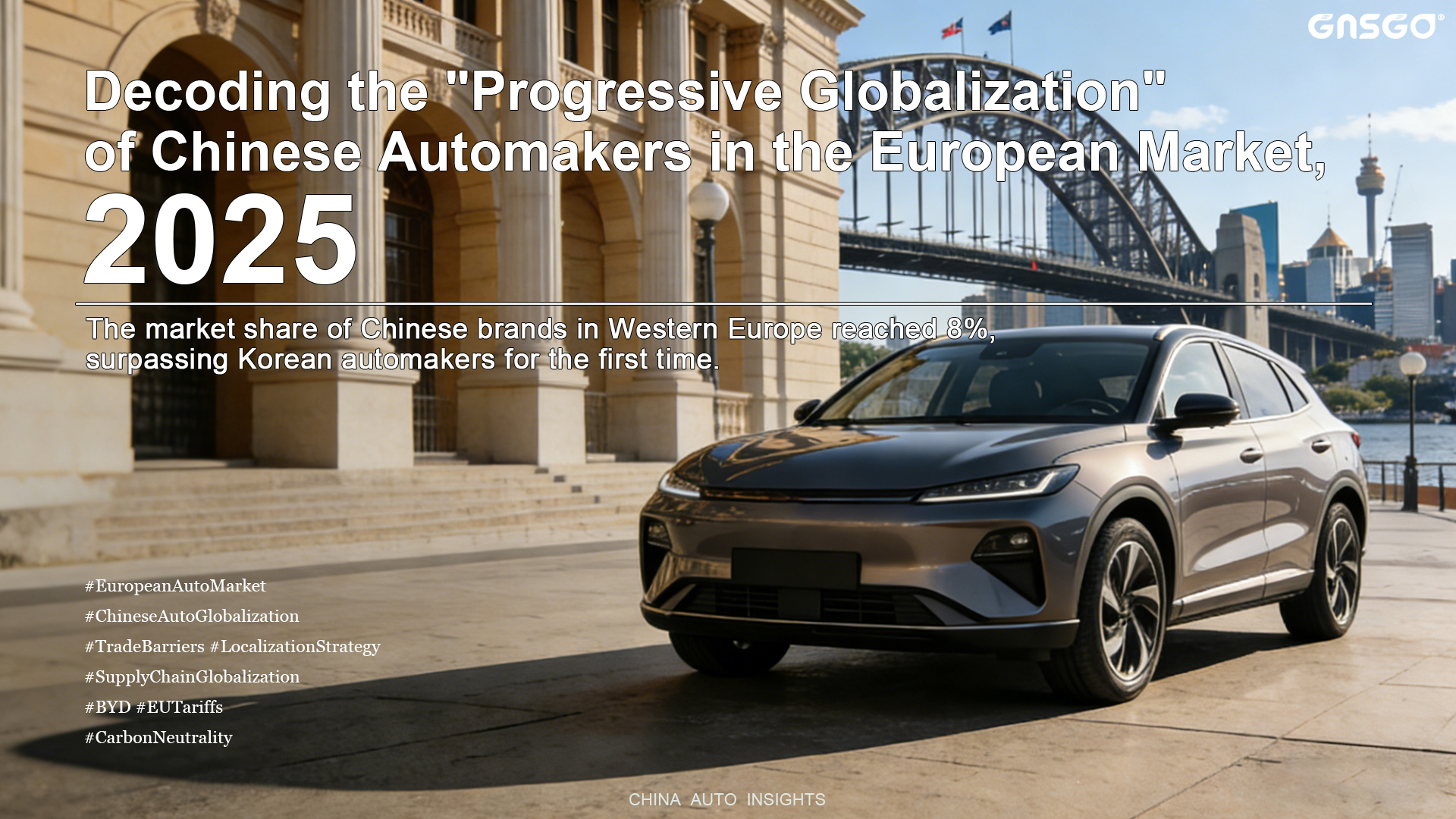
Growth Against Headwinds: Despite facing EU countervailing duties of up to 45%, the total sales of Chinese automobiles in the European market still achieved near doubling growth in 2025. The market share of Chinese brands in Western Europe reached 8%, surpassing Korean automakers for the first time.
Key Breakthroughs: In core markets, BYD’s annual sales in Germany are expected to surpass Tesla; in France, annual sales of Chinese brands are projected to exceed the 50,000-unit milestone.
Model Upgrade: To counter barriers, collaborative industrial chain globalization has become a new trend. OEMs like BYD (Hungary) and Chery (Spain) are accelerating local factory establishment, while component giants like CATL (Hungary) are following suit, building a cluster-based globalization ecosystem.
In-Depth Analysis
Current challenges have transcended mere trade friction, escalating into a comprehensive test of “system adaptability.” The digital passport requirement of the EU’s New Battery Regulation is an ultimate challenge to the entire industry chain’s carbon management and data transparency; the AI Act and GDPR pose high compliance pressure on China’s intelligent driving and data ecosystems. This necessitates a complete overhaul of Chinese automakers’ technological, production, and data management systems, with complexity and costs far exceeding tariff countermeasures. Meanwhile, the current situation of after-sales service network coverage being less than one-third of competitors exposes localization as an ongoing “soft underbelly.” Insufficient brand premium and cultural differences signify that winning hearts and trust is an even longer battle after gaining market share.
The response strategies of Chinese automakers outline a roadmap for advancing from “participant” to “shaper”:
Localization Leap: From CKD assembly (Chery) to greenfield plant construction (BYD), and further to cooperation with top-tier suppliers like Magna (Xpeng), the depth of localization directly determines the safety margin for cost and compliance.
Ecologization Leap: The cluster-based globalization of “vehicle + core components + energy infrastructure” (e.g., CATL and NIO Power setting up in Hungary) aims to replicate a highly resilient “miniature version of the Chinese supply chain ecosystem” in Europe, achieving synergies.
Value Leap: Through continuous innovation in areas like intelligent driving and battery technology, coupled with active participation in European R&D and collaboration, the goal is to shift from relying on “cost-performance” to offering “technology premium,” ultimately participating in or even influencing the setting of industry technical standards.
Industry Insights
True globalization is “system globalization,” and its highest form is “standards globalization.” The next phase for Chinese automobiles in Europe will shift the competitive focus from “how many vehicles are exported” to “how deep an industrial ecosystem can be built locally” and “whether internationally recognized technical and management standards can be output.” The process of countermeasures regulations like the New Battery Regulation is precisely an opportunity that forces the Chinese industrial chain to enhance transparency and build global compliance capabilities, thereby internalizing them as participants in international standards. Localization must enter the stage of “value network generation,” not just “physical node layout.” Building factories and opening stores are only the first steps. True localization involves generating a value creation network locally that integrates R&D, procurement, production, marketing, finance, and service. This requires attracting and cultivating local talent, forming deep bonds with local suppliers and financial institutions, and deeply embedding one’s business into the fabric of the local economy, becoming an inseparable part. The core of a brand “moving up” is a cognitive revolution from “cost leadership” to “value leadership.” In the European market, relying solely on “cost-performance” cannot endure cycles nor support sustainable R&D and service investment. Chinese brands must establish new value anchors in consumers’ minds through leading technological experiences (e.g., ultra-fast charging, high-level autonomous driving), unique design aesthetics, and trustworthy quality and service, completing the cognition leap from “Made in China” to “China Brand.”
EuropeanAutoMarket ChineseAutoGlobalization TradeBarriers LocalizationStrategy SupplyChainGlobalization BYD EUTariffs CarbonNeutrality