Geely Sold 4.11 Million Vehicles in 2025
Core Data/Events
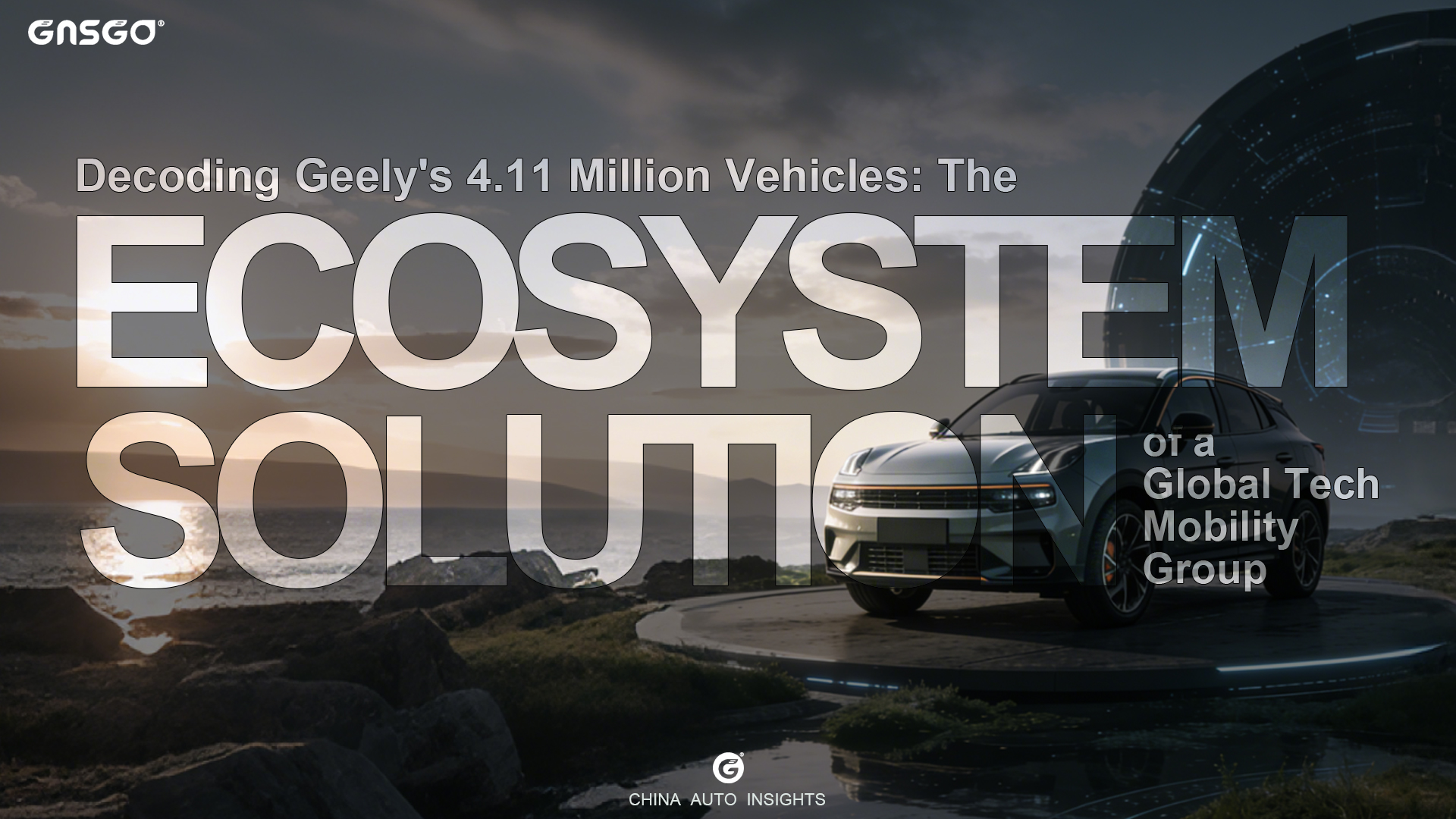
In 2025, Geely Holding Group’s global total sales reached 4.116 million vehicles, a year-on-year increase of 26%,first time surpassing the 4 million mark. New energy vehicle sales accounted for 2.293 million, surging 58% year-on-year, with a penetration rate of 56%—meaning one out of every two vehicles sold was an NEV.
Brand Divergence and Synergy:
Geely Auto (including Galaxy, Lynk & Co, Zeekr): Sales reached 3.0246 million vehicles, a sharp increase of 39% YoY, serving as the absolute growth engine for the group. The Geely Galaxy brand alone sold 1.2358 million vehicles, a remarkable 150% growth, becoming a phenomenal product line.
Volvo Cars: Global sales were 710,000 vehicles, down 7% YoY. However, its NEV sales in the Chinese market against the trend increased by 71%, indicating an accelerated electrification transformation in this critical market.
Yuan Cheng New Energy Commercial Vehicle: Sales reached 162,019 vehicles, ranking first in the industry for the fourth consecutive year. Its overseas business skyrocketed nearly 500% year-on-year, covering 26 global markets, making it a “vanguard” of globalization.
From Proton, which holds a 19.4% market share in Malaysia, to Lynk & Co and Polestar deepening their presence in Europe, Geely’s brands have established a diversified and differentiated market layout worldwide.
In-Depth Analysis 1. The Ecosystem Synergy of “One Geely”: Technology Democratization and Optimal Global Resource Allocation The foundation of Geely’s 4.11 million vehicles is not a simple sum of its brands but the powerful ecosystem synergy formed under its “One Geely” strategy.
Global “Trickle-down” and “Ascent” of Technology: The “Air-Space-Ground Integrated” technological ecosystem is Geely’s core moat. Within this system, cutting-edge technologies flow efficiently between brands. For instance, the group’s unified “Qianli Haohan” intelligent driving system and self-developed Shen Dun Gold Brick Battery empower not only premium brands like Zeekr and luxury brand Lotus but are also gradually applied to mass-market brands like Galaxy, achieving “technology democratization.” Meanwhile, safety technologies and engineering capabilities from Volvo continuously feed back into the entire group, accomplishing a technological “ascent.”
Global Resilient Supply Chain Layout: Facing a complex international trade environment, Geely mitigates risks through a global production and supply chain network. Volvo’s European plants, Proton’s ASEAN base, and Geely’s global KD factories complement the domestic manufacturing system. This layout not only avoids regional trade barriers (e.g., enabling Yuan Cheng to quickly seize European and American markets) but also achieves supply chain resilience and optimal cost control.
- The Dual Poles of Growth: “Endogenous Explosion” of Owned Brands and “Transformational Restructuring” of Global Assets Geely’s growth chart shows a clear “dual-pole” trend, revealing its unique development logic.
Pole One: “Endogenous Explosive Growth” of Owned Brands. The owned brands, represented by Geely Galaxy and Zeekr, contribute the most significant increment. This stems from precise and rapid responses to domestic market demands. Galaxy cut into the mainstream family market with hybrid technology, while Zeekr targets tech-luxury with pure electric architecture, both creating “blockbuster” effects in their segments. This growth is a concentrated outbreak of product power, brand power, and channel power within a mature market.
Pole Two: “Strategic Transformation and Restructuring” of Global Assets. Global brands like Volvo, Proton, and Lotus are in deep transformation. Volvo’s global sales decline coexists with its high NEV growth in China, reflecting the pains and opportunities traditional premium brands face in the electrification wave. Proton’s stability in ASEAN and Lotus’s focus on electric hypercars exemplify Geely’s “localized operations” and “brand value recasting” of different assets. The value of these brands is evolving from mere sales contribution to being “technology bridgeheads,” “brand value anchors,” and “regional market pivots.”
- The Underestimated “Second Curve”: The New Globalization Paradigm Revealed by Yuan Cheng Commercial Vehicles The nearly 500% explosion in overseas business of Yuan Cheng New Energy Commercial Vehicle is a strategically significant signal.
The Amplified Global Effect of Commercial-Passenger Vehicle Synergy: Yuan Cheng’s outbreak is not an isolated incident. It fully benefits from the new energy supply chain, three-electric technology, and intelligent foundation built by the passenger vehicle sector. Applying these technologies to commercial vehicles in markets with stringent environmental regulations like Europe creates a form of overmatch through “technology spillover” .
From “Product Export” to “Ecosystem Standard Export”: Yuan Cheng’s success marks a new phase in Chinese automotive globalization. It is no longer about selling low-cost products but exporting “integrated new energy solutions,” including vehicles, charging/swapping infrastructure, and even operational models. This opens up a global commercial vehicle market far larger and with higher barriers than the passenger vehicle market for Geely. Its “30111” strategy (aiming for 1 million annual sales by 2030) demonstrates the ambition to turn this “second curve” into a “main growth driver”.
Industry Insights
The future competition in the global auto industry will be “ecosystems” versus “single companies.” Geely’s case shows that an ecosystem capable of technology sharing, supply chain synergy, complementary brand portfolios, and global market coverage possesses far greater risk resilience and growth potential than companies relying on a single brand or technology. Building or integrating into such an ecosystem will become a core strategy for automakers.
True globalization is the globalization of “capabilities,” not just “products.” What Geely demonstrates through Yuan Cheng is the capability to package and export R&D, manufacturing, supply chain, and business models. This “systematic globalization” not only captures market share but also enables participation in or even leadership in setting industrial standards for local markets, thereby establishing more enduring and profound competitive barriers.
GeelyHolding 2025Sales GlobalStrategy NewEnergyVehicles EcosystemSynergy YuanChengCommercialVehicles Volvo Zeekr