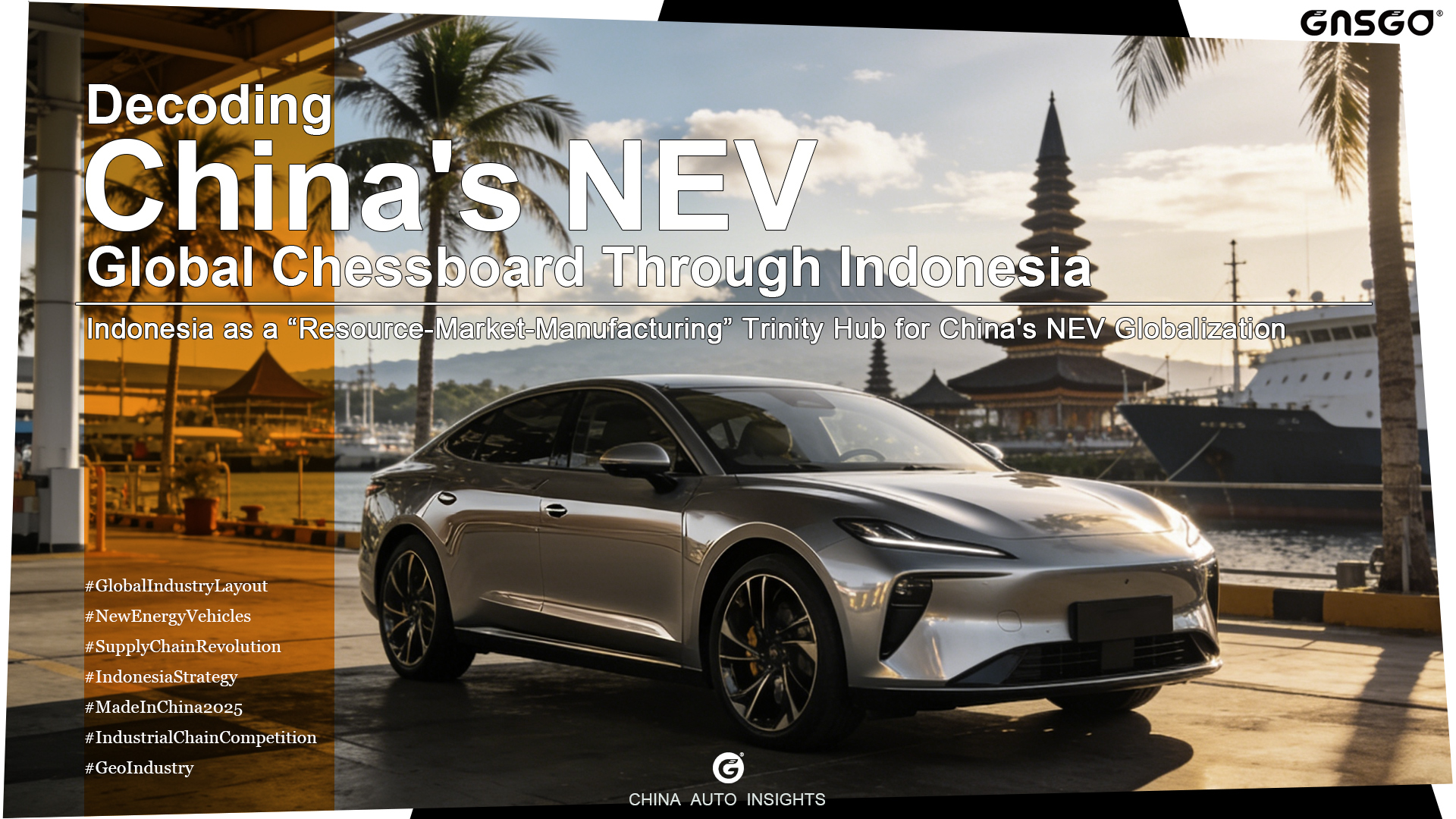
Decoding China's NEV Global Chessboard Through Indonesia
Core Data/Events
Critical Resource & Market: Indonesia holds 52% of global nickel resources and aims for 30% EV penetration by 2030. With annual vehicle sales exceeding 1 million units, it is Southeast Asia’s largest single market.
Dominance of Chinese Industry: In 2024, Chinese brands captured nearly 70% of Indonesia’s BEV market share. Led by BYD and Wuling, Chinese automakers have shifted their strategy from “product trade” to “localized manufacturing” and “full industrial chain investment.”
A Microcosm of Global Strategy: The Indonesia case epitomizes the global expansion logic of China’s NEV industry: Securing critical resources (nickel) → Establishing regional manufacturing hubs (assembly plants) → Dominating emerging markets (sales) → Exporting industrial standards.
In-Depth Analysis 1. Strategic Positioning: Indonesia as a “Resource-Market-Manufacturing” Trinity Hub for China’s NEV Globalization Indonesia is not an ordinary overseas market; it is a critical hub for the “stress testing” and “model export” of China’s NEV industrial chain. Its value lies in three irreplaceable dimensions:
Resource Security Pivot: The global power battery race is fundamentally a competition for “nickel.” By investing in nickel smelting, battery materials, and production in Indonesia, Chinese firms deeply embed the uppermost stream of the supply chain into their own system. This is a strategic layout to hedge against future resource supply risks and secure global capacity expansion.
Regional Manufacturing Center: The Indonesian government exchanges market access and resources for investment and technology. BYD, Wuling, and others building plants there aim not only for local sales but also to leverage “zero-tariff” access within ASEAN, establishing it as a “regional manufacturing and export base” radiating across Southeast Asia, replicating the efficiency and cost advantages of “Made in China.”
Emerging Market Template: Indonesia’s consumption structure, policy environment, and infrastructure level are highly representative of Southeast Asia. Successful product definitions (e.g., small EVs), business models (e.g., battery leasing), and supply chain solutions here become “standardized modules” rapidly replicable in other ASEAN countries like Thailand and Vietnam.
- Industrial Evolution: The Paradigm Shift from “Product Export” to “Ecosystem Export” The Indonesian front clearly reveals the profound evolution of China’s auto industry globalization path:
Era 1.0: Product Trade: Exporting finished vehicles, competing on price-performance, with a short value chain vulnerable to trade barriers.
Era 2.0: Localized Manufacturing: Establishing KD/CKD plants for localization, but core components remain import-dependent.
Era 3.0: Ecosystem Export (Current Phase): Using Indonesia as a blueprint, exporting a complete industrial ecosystem of “vehicle assembly + core Three-Electric tech + supply chain clusters + after-sales service standards.” Wuling’s localization rate exceeding 40% and its traction of Chinese supplier clusters signify China’s auto industry has begun “systemic capability export.”
- Global Impact: Reshaping a China-Centric “Parallel Supply Chain” and Industrial Order China’s deepfootprint in Indonesia and Southeast Asia is having far-reaching global effects:
Building a “Parallel Supply Chain”: Giants represented by CATL and BYD are constructing a global NEV “parallel supply chain” independent of the traditional auto industrial system (Europe-US-Japan), deeply tied to Chinese technical standards and core components, through battery and vehicle plants in key nodes like Indonesia, Hungary, and Mexico.
Controlling Rule-Making Power: Exporting industrial ecosystems is essentially exporting “standards” and “rules.” When most EVs on Indonesian streets adopt Chinese battery standards, smart cockpit systems, and fast-charging protocols, China becomes the de facto definer of new technical rules in the region—a value more enduring than market share.
Altering Global Competitive Dynamics: The success of the Chinese industrial chain in Indonesia forces Japanese, Korean, and European automakers to reassess their Southeast Asia strategies, shifting from past “market dominance” to “defensive investment.” The global NEV competition has escalated from single-company product rivalry to “industrial chain cluster” competition with national or regional backdrops.
Industry Insights
Future globalization is “industrial chain vs. industrial chain” competition. The success of a single company will increasingly depend on the global deployment capability and synergy efficiency of the national or regional industrial cluster it belongs to. What China demonstrates in Indonesia is precisely the advantage of this “systematic warfare.”
Controlling “Resource Transformation Nodes” is More Critical than Owning the Resources. Indonesia’s lesson is that it seized the initiative in value chain upgrade by using policy to force the transformation of “nickel ore” into “battery materials.” Chinese companies’ global investments must target those key node countries capable of transforming “resource endowments” into “industrial products” for capacity layout.
China’s Auto Industry is Transitioning from a “Globalization Participant” to a “Builder of Localized New Orders.” In regions like Southeast Asia, through deep integration, the Chinese industrial chain is constructing a “regional new industrial order” centered on its own technology and supply chain. This marks the industry’s entry into a new phase of exporting influence and defining rules.
GlobalIndustryLayout NewEnergyVehicles SupplyChainRevolution IndonesiaStrategy MadeInChina2025 IndustrialChainCompetition GeoIndustry