Australia 2025: Chinese Brands Make It a Proving Ground
Core Data/Events
Australia’s new vehicle sales reached 1,241,037 units in 2025, setting a historical record for the third consecutive year, demonstrating strong market resilience.
Represented by GWM, BYD, MG, and Chery, Chinese brands saw their annual market share rise to approximately 18%, with significant year-on-year sales growth. Both GWM and BYD broke into the annual top ten brand sales rankings, with BYD’s sales surging by 156.2%.
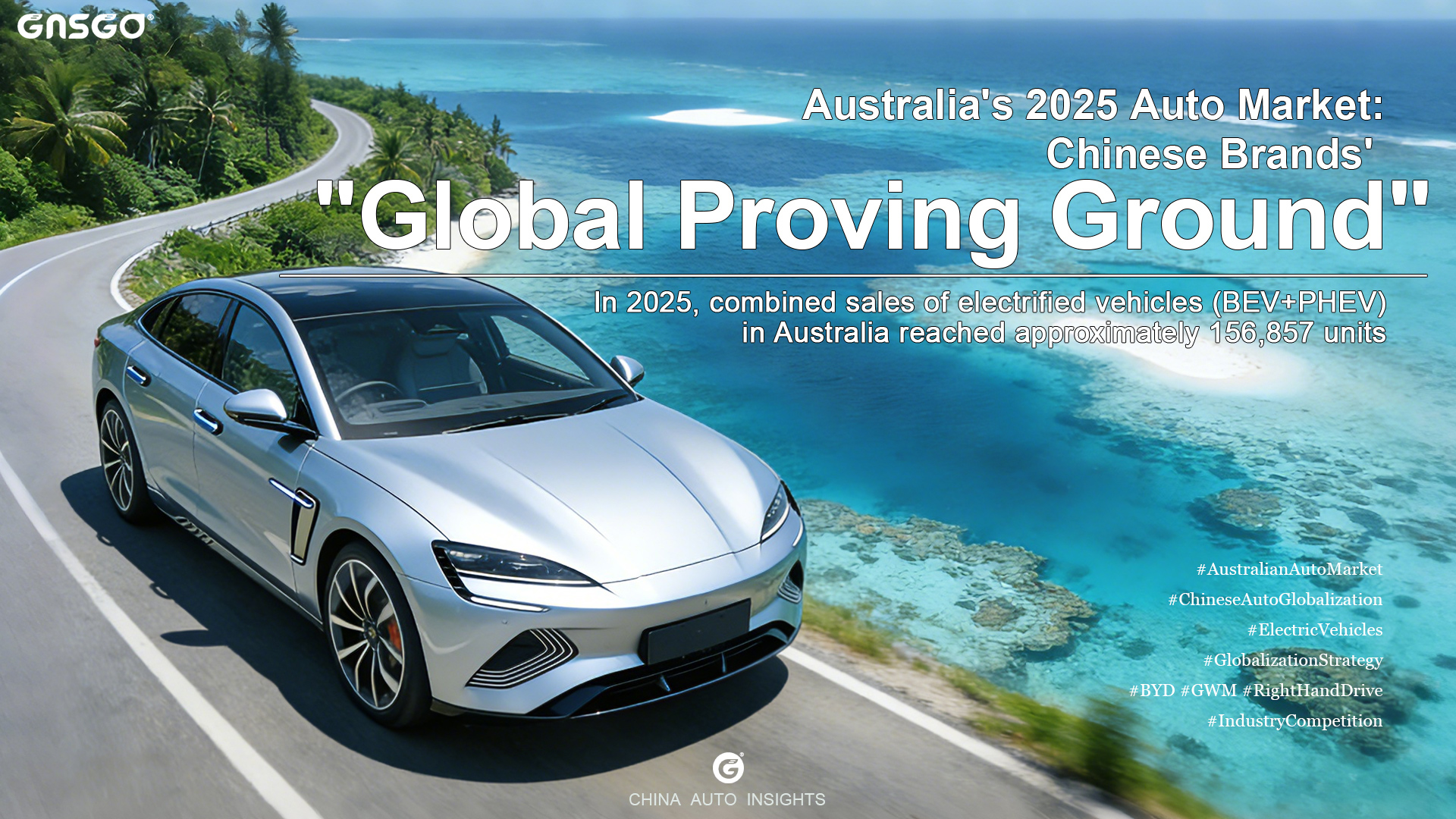
Accelerating Electrification: In 2025, combined sales of electrified vehicles (BEV+PHEV) in Australia reached approximately 156,857 units, capturing 12.1% market share, with a growth rate of 24.4% in the first half of the year. Chinese brands were a core driving force, with the BYD Sealion 7 becoming the second best-selling pure electric model.
In-Depth Analysis Strategic Value: Why is Australia a “Must-Win Battleground” and “Touchstone”?
Barrier-Free Open Market: With the complete exit of local automotive manufacturing in 2017, the Australian market has almost no trade protectionist barriers, making it one of the world’s purest and most fiercely competitive markets. It hosts over 70 brands, a veritable “United Nations of car brands”. Success here means product strength has passed the most stringent test.
Strategic Hub for RHD Markets: The experience accumulated in conquering the Australian RHD market—in product adaptation, regulatory certification, channel development, and brand operation—holds immeasurable “template value” for Chinese brands entering other major RHD markets like the UK, Southeast Asia, and New Zealand.
Trust Threshold in Developed Markets: Australian consumers are mature and rational, highly sensitive to brand heritage, product reliability, and resale value. Winning their acceptance is a crucial step for Chinese brands to shed the “cheap label” and build global brand credibility. Industry reports also note China is accelerating to become the global automotive industry’s technological leader.
Path to Success: How Did Chinese Brands Transition from “Breaking In” to “Establishing Themselves”?
“Value Competition” Beyond “Cost-Performance”: Initially, Chinese brands entered the market with feature-rich, affordable offerings. However, the victories of 2025 show competition has escalated into a contest of “comprehensive value systems.” This includes electrification and intelligent technology rivaling or surpassing peers (e.g., BYD’s DM-i/p, XPENG’s ADAS), engineering adaptations for local harsh conditions (e.g., heat, long distances), and rapidly improving after-sales service networks.
Precision “Market Wedge” Strategy: Chinese brands did not spread efforts evenly but chose to “precision blast” the most dominant segments. For instance, BYD used the Shark hybrid pickup to strike at the heart of Australian car culture—the pickup market—challenging traditional ICE champions with technological advantages. Chery leveraged the Tiggo series SUVs to meet family user needs with high cost-performance, rapidly capturing share. This “hero product” strategy efficiently tore open market gaps.
Evolution from “Product Export” to “Ecosystem Landing”: Leading brands are no longer content with mere vehicle sales. They are accelerating the development of localized sales channels, charging networks (e.g., GAC Aion’s plan for 300 superchargers), and exploring deep cooperation with local dealers and supply chains. This “ecosystem” approach aims to build long-term, sustainable competitive moats.
Industry Insights
True globalization capability is forged in an “open arena.” Protected or rapidly growing markets can mask capability shortcomings. “High-difficulty open markets” like Australia are the ultimate proving grounds for testing genuine product competitiveness, brand resilience, and localized operational capabilities. Success here yields experience with greater universality and replicability.
The dimension of competition has escalated from “features and price” to “technological systems and ecological efficiency.” In the future, victory will be determined not just by a single vehicle’s range or screen size, but by the complete electrification platform behind it, the rapidly iterating electronic/electrical architecture, the cost-controllable supply chain, and the efficient user-reach service network. This is the concrete manifestation of the overall advantages of Chinese manufacturing within the automotive industry.
The depth of localization determines the height of market position. Initially relying on product imports can open the door, but long-term dominance inevitably stems from deep localization: forming a community of interest with local dealers, establishing efficient parts warehousing and logistics systems, and targeted R&D for local needs. Whoever more fast completes the identity transition from a “global brand from China” to a “local brand in Australia” will win the future.
AustralianAutoMarket ChineseAutoGlobalization ElectricVehicles GlobalizationStrategy BYD GWM RightHandDrive IndustryCompetition