Algeria's $27.4 Billion Import Plan for Auto Suppliers
Core Data/Events
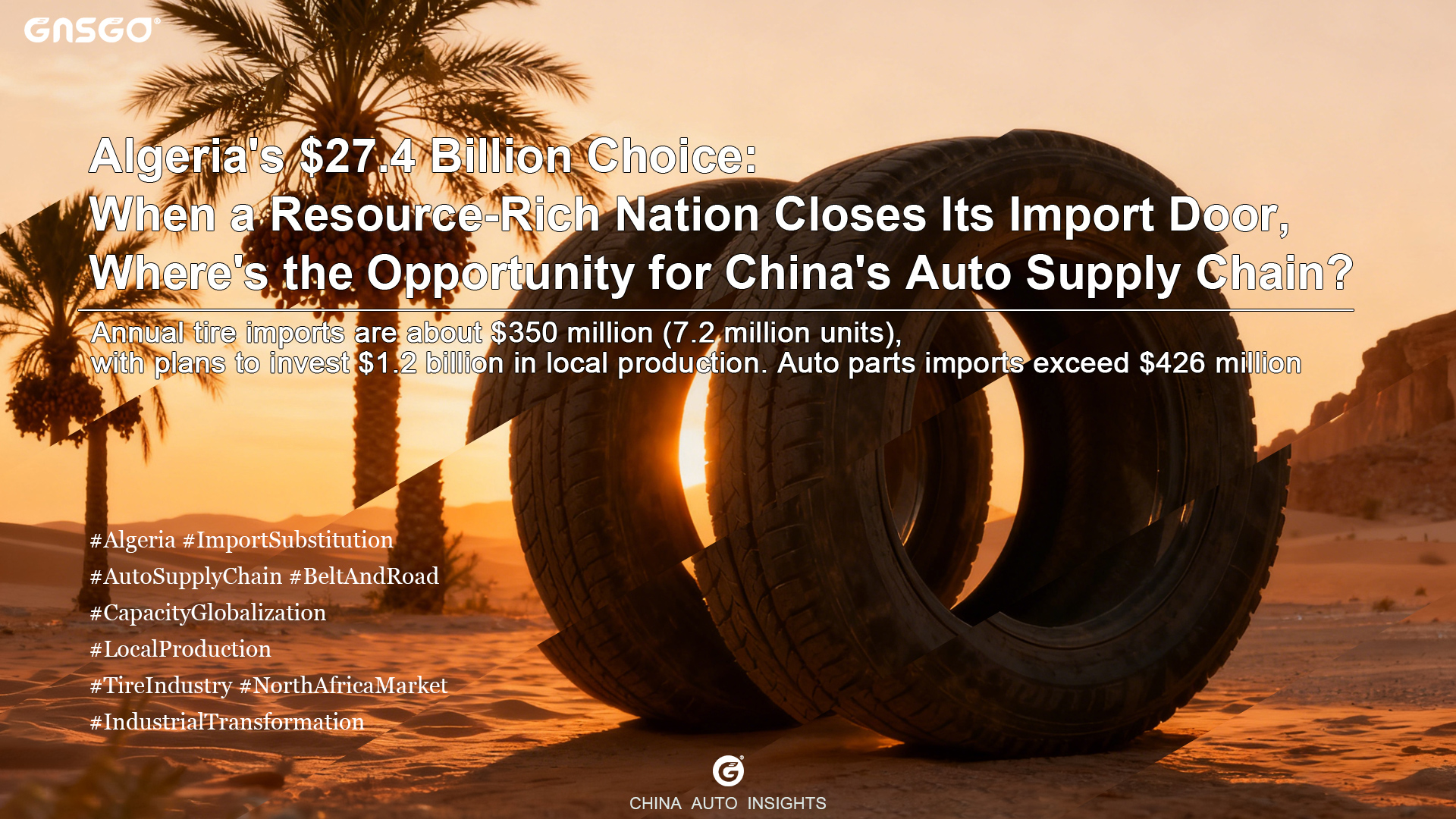
Algeria has launched a $27.4 billion import substitution strategy, planning 7,656 projects aimed at creating over 270,000 jobs and reducing dependence on oil and gas revenues. The strategy prioritizes tires and automotive components as one of three key breakthrough areas. Specifically, annual tire imports are about $350 million (7.2 million units), with plans to invest $1.2 billion in local production. Auto parts imports exceed $426 million, with 158 local projects already underway. The strategy’s core is not merely to restrict imports but to build an efficient and competitive local production system to fundamentally meet domestic demand and achieve economic restructuring.
In-Depth Analysis Strategic Essence: A “Necessary” Revolution in Supply Chain Localization
Algeria’s choice is a strategic breakthrough for a resource-dependent country squeezed by the triple pressures of the global energy transition, foreign exchange reserve strain, and high domestic unemployment (particularly youth). Its logic is not trade protectionism but “survival industrialization”: using the final dividend of oil and gas wealth to urgently build foundational industrial capabilities, especially in sectors tied to vast domestic consumption like automobiles. This signals a fundamental shift in the market logic facing China’s supply chain: from being a “supplier of good and cheap goods” to becoming a partner in technology, capital, and production capacity.
Dual Challenge: The Paradox of “Substitution” and “Integration” for China’s Supply Chain
In the short term, this is a clear substitution signal. Annual imports of tires and parts worth hundreds of millions of dollars will gradually shift to local production, directly pressuring the traditional export model. However, viewed deeply, this creates higher-level integration opportunities. Algeria’s plan soberly acknowledges its own weaknesses: technology, human resources, and project operation. These are precisely the core strengths of China’s supply chain enterprises honed through decades of globalization. The new rules of the game are no longer about selling products but about selling production lines, technical standards, and management systems to help Algeria achieve “self-production.”
Strategic Window: Cognitive Shift from “Cost Depression” to “Capacity Springboard”
Algeria possesses the largest market in North Africa, relatively low energy costs, and proximity to Europe. If Chinese supply chain firms view it only as a sales market, they will shrink due to import substitution policies. However, if they can reshape it into a “regional manufacturing base” face Europe and Africa, new opportunities emerge. Establishing local joint ventures can meet Algeria’s localization requirements and incentives while leveraging its trade agreement network with the EU and African nations, enabling a secondary layout of “Made in Algeria,radiation to surrounding markets.”
Industry Insights
Globalization models must upgrade from “trade export” to “capacity and standards export.” The Algeria case is a microcosm of global industrial chain regional restructuring. Chinese auto supply chain firms (especially tire and parts giants) must integrate overseas localized production into their core strategy. The key to success lies not in resisting localization but in proactively participating in and leading the localization process, offering a “packaged” export of China’s manufacturing systems, technical standards, and management experience. The key to win-win cooperation is “filling capability gaps,” not “competing for market share.” Collaboration with the Algerian government and businesses should start from the pain points highlighted in its strategic report: project feasibility analysis, production technology improvement, skilled talent training, and supply chain cluster building. Chinese companies should position themselves as “industrial capability enablers,” sharing industrialization dividend through diverse means like JVs, technology licensing, and management consulting, rather than merely competing for end-product market share.
Algeria ImportSubstitution AutoSupplyChain BeltAndRoad CapacityGlobalization LocalProduction TireIndustry NorthAfricaMarket IndustrialTransformation