Chery Buys Nissan's Rosslyn Plant in South Africa
Core Data/Events
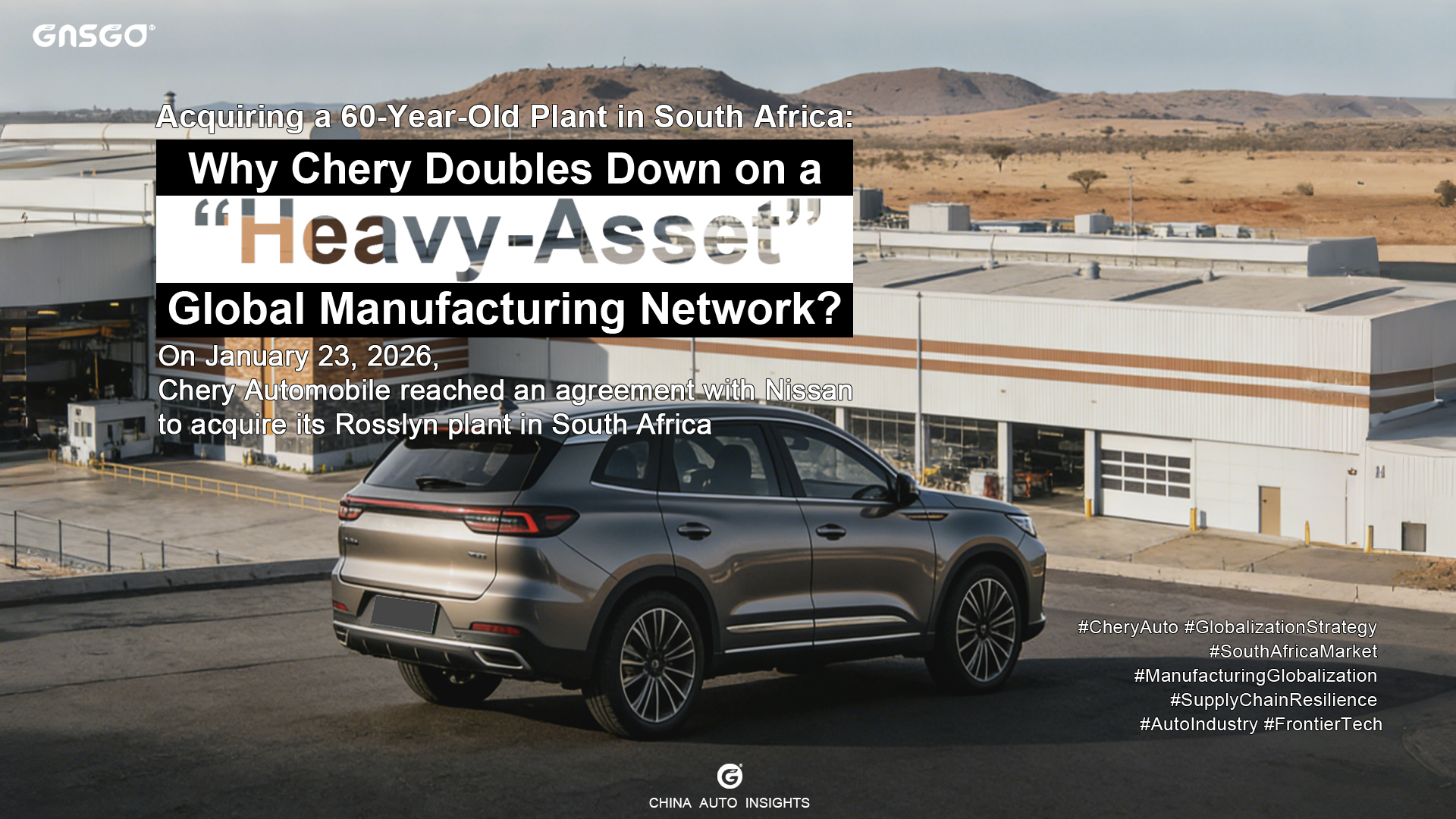
On January 23, 2026, Chery Automobile reached an agreement with Nissan to acquire its Rosslyn plant in South Africa. With nearly 60 years of history and complete manufacturing processes, the plant has an annual capacity of approximately 50,000 vehicles and will become Chery’s first complete vehicle manufacturing base in Africa.
This acquisition is the latest piece in Chery’s global production puzzle. Its manufacturing network already covers Malaysia (Southeast Asia) and Spain (Europe), with CKD assembly plants in multiple countries including Egypt, Mexico, and Brazil, systematically forming a global capacity layout.
In 2025, Chery maintained its position as China’s top auto exporter for the 23rd consecutive year with overseas sales of 1.344 million units. For 2026, the company has set an ambitious annual sales target of 3.2 million units and plans to launch 17 new models across all powertrain types.
In-Depth Analysis Beyond the “Trade Window”: Building Permanent “Local Manufacturing” Access The acquisition of the South African plant marks Chery’s globalization strategy entering a more profound phase: shifting from leveraging the “window of trade dividend” for product exports to constructing permanent market access and risk barriers through “heavy-asset manufacturing layout”.
Securing an African “Bridgehead”: South Africa is the most industrialized market with the most mature automotive supply chain in Africa, enjoying tariff preferences for radiation the Southern African Development Community (SADC). Acquiring a ready-made, market-proven plant is far more efficient than building from scratch. This allows Chery to quickly obtain the “ID card” of localized production, hedge against potential trade policy fluctuations, and deeply cultivate the entire African continent using South Africa as a hub.
“Contrarian” Assetization Thinking: Amid the NEV wave, many international automakers are shrinking or adjusting their traditional ICE capacity. Chery’s move represents a “contrarian” strategic assetization operation. It acquires valuable local production qualifications, an existing skilled workforce, established supply chain relationships, and dealer networks at a relatively reasonable cost. This “takeover-renovation-upgrade” model carries lower risk and faster implementation than fresh “greenfield investment.”
The Logic of the “Global Manufacturing Network”: From “Point Export” to “Network Synergy” Chery’s global layout is not a series of isolated outposts but a meticulously woven “global manufacturing and supply chain synergy network.” Each node serves a distinct strategic function:
Regional Manufacturing Hubs (e.g., South Africa, Spain plants): Responsible for deep localization, market responsiveness, and regional radiation within their continents. They require high localization rates to cope with tariffs and meet local regulations.
CKD Assembly Bases (e.g., Egypt, Mexico plants): Act as “light-asset outposts” for rapid market penetration. Using the more flexible loose parts assembly model, they adapt to the scale demands of different markets in their early stages and lay the groundwork for potential future upgrades to full-process plants.
Technology & Product Hubs (China HQ & Global R&D Centers): Feed the global network with vehicle platforms, core technologies, key components, and management standards. This network structure, combining a “hub-and-spoke” model with “multi-point linkage,” endows Chery with remarkable resilience to cope with regional market fluctuations, optimize logistics costs, and flexibly allocate capacity.
Industry Insights
The Second Half of Chinese Auto Globalization is a Contest of “Localized Manufacturing Capability.” The early dividend period of exports is fading. What will determine future market share is who can more efficiently and deeply achieve the full-chain localization of “R&D-procurement-production-sales-service” in key regional markets. Acquiring mature assets is an efficient shortcut to obtaining this “localization capability.” The Boundary Between Traditional Manufacturing Giants and Tech Pioneers is Blurring. Chery’s 2026 strategy clearly outlines a “two-front war” roadmap: one front continues to consolidate and expand its physical network as a “global automotive manufacturer”; the other front all-out transforms into a “frontier technology enterprise.” This suggests that future industry leaders must be hybrids of “manufacturing masters” and “technology pioneers.”
CheryAuto GlobalizationStrategy SouthAfricaMarket ManufacturingGlobalization SupplyChainResilience AutoIndustry FrontierTech