NIO's European Strategy and the Firefly's Mission
Core Data/Events
Strategic Shift: After four years in Europe, NIO made a significant model transition in 2025: pivoting from the high-cost direct sales model to a “capital-light” agency model operated by regional general agents.
Market Performance: Over the past four years, NIO’s cumulative sales in its five key European markets (Norway, Germany, Netherlands, Denmark, Sweden) reached only around 7,000 vehicles, with 61 battery swap stations built.
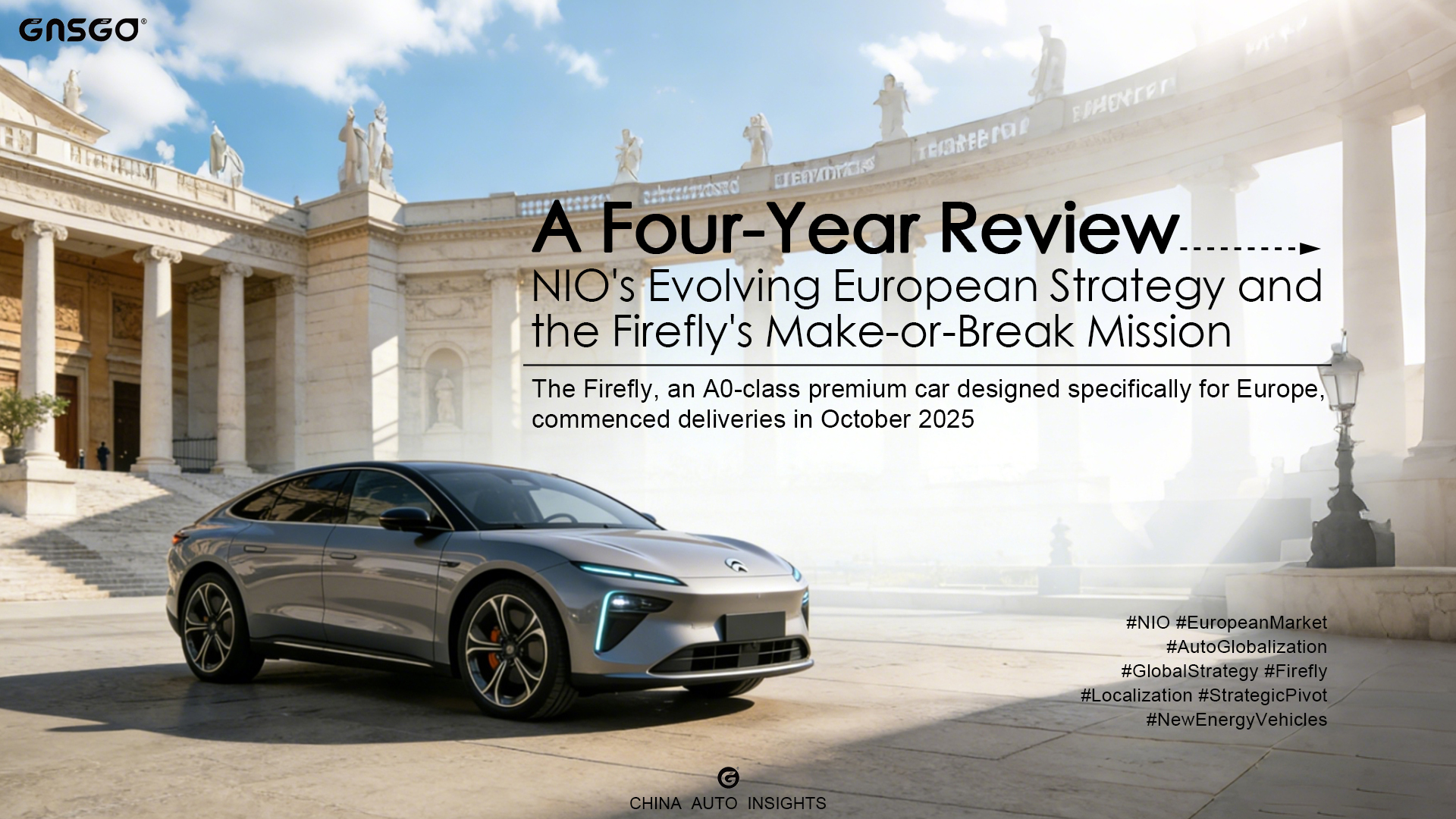
Core Product: The Firefly, an A0-class premium car designed specifically for Europe, commenced deliveries in October 2025. It achieved a 5-star ENCAP safety rating and targets the European premium compact car segment with an annual volume of around 4 million vehicles.
In-Depth Analysis
Strategic Reconfiguration: Shifting Focus from “Infrastructure-Driven” to “Product-Driven”
Initially, NIO attempted to fully replicate its successful Chinese formula of “User Experience (Service + Battery Swap) - Premium Brand” in Europe. However, with zero brand awareness and lacking economies of scale, upfront heavy investment in infrastructure (NIO Houses, swap stations) led to disproportionately high fixed costs, trapping it in a vicious cycle of “high investment - slow conversion - heavy losses.” The 2025 model transition marks a strategic pivot from “system replication” to “product breakthrough.” The Firefly is the key piece in this new logic: a “market-specific product” with deep local design, precisely fitting Europe’s mainstream consumption scenario (small car demand) and price segment (premium compact). Its success will depend less on swap station density and more on the product’s inherent market penetration.
Path to Breakthrough: The Firefly’s Opportunity and NIO’s Systemic Challenges
The Firefly correctly targets a core European market gap: a shortage of supply in the premium compact car segment, and its 5-star ENCAP rating builds a foundation of safety trust. However, its success faces three layers of systemic challenges:
Validation of the New Model: Can the new agency model ensure brand tone and service quality while achieving rapid network penetration and cost control?
Deteriorating Competitive Landscape: Its price competitiveness is undermined by EU tariffs, while it must face strong local rivals like MINI and upcoming competitors like the Volkswagen ID.2.
Organizational Capacity Bottleneck: NIO must prove its headquarters can effectively manage complex multi-country agents and, with limited resources, achieve a “breakthrough in key markets” like the UK (tariff-free window) before radiating success to surrounding regions.
Industry Insights
There is No “Standard Answer” for Globalization; Deep Localization is the Only Cure. NIO’s case starkly reveals that successful models from China cannot be directly exported. Successful globalization must start with respect and deep learning of the target market’s politics, regulations, culture, and infrastructure. Equating “Norway” with “Europe” was the costliest cognitive bias in the early stage.
Strategic Cadence is Critical; “Product First” Trumps “System First.” For new entrants with weak brand power, prioritizing scarce resources to develop a star product that “precisely resonates” with local demand is far more effective than blindly replicating the full ecosystem from the home market. Using a product to build market awareness, then gradually supporting it with services based on momentum, is a more robust path.
NIO EuropeanMarket AutoGlobalization GlobalStrategy Firefly Localization StrategicPivot NewEnergyVehicles