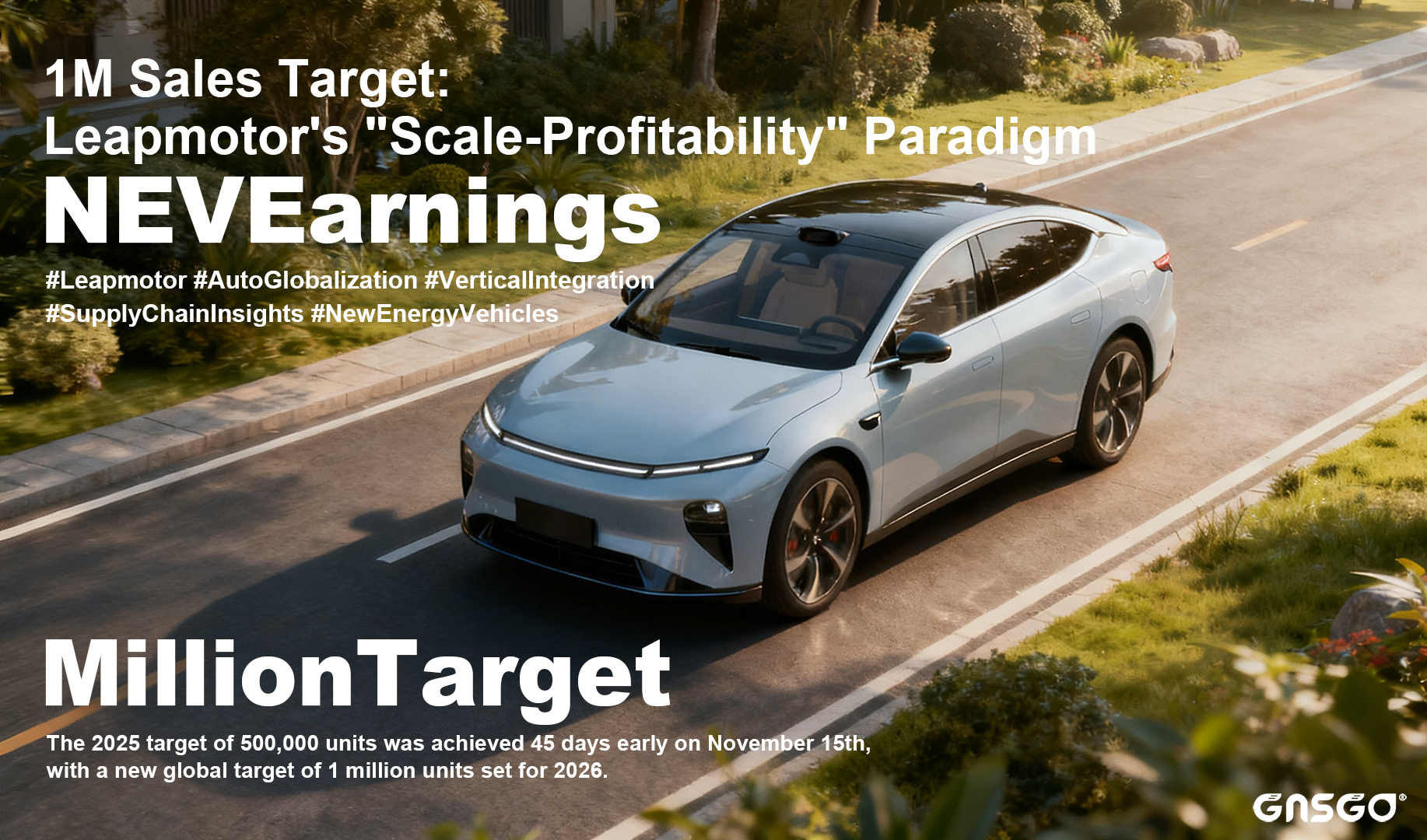
1M Sales Target: Leapmotor's "Scale-Profitability" Paradigm
Core Data/Events
-
Profitability Inflection Point Confirmed: Q3 2025 net profit reached ¥150 million, maintaining consecutive quarterly profitability. Gross margin rose to 14.5%, up over 6 percentage points YoY.
-
Revenue and Sales Double: Q3 revenue hit ¥19.45 billion, up 97.3% YoY. Sales volume reached 173,852 units, surging 101.8% YoY, securing the top spot among Chinese NEV startups.
-
Annual Target Achieved Ahead of Schedule: The 2025 target of 500,000 units was achieved 45 days early on November 15th, with a new global target of 1 million units set for 2026.
-
Overseas Business as New Engine: Q3 exports were 17,397 units. Cumulative overseas deliveries from Jan-Oct exceeded 44,000 units, with monthly overseas orders in October surpassing 12,000 units
In-Depth Analysis “Scale-Profitability” Model Validated: The Cost Moat of Full-range R&D
-
Through full-range R&D (covering about 60% of BOM cost), Leapmotor achieves ultimate cost control. Its LEAP 3.5 architecture shortens harness length to 996 meters, reduces ECUs to 22, and integrates thermal management into 27-in-1, slashing parts count and energy consumption.
-
This enables a “high-spec, low-price” strategy in the ¥100k-200k mass market (e.g., B10 brings lidar models to the ¥110k level), creating a strong “technology democratization” edge.
Globalization 2.0: From “Trade Export” to “Localized Ecosystem”
-
Driven by a Dual-track Model: Leveraging the JV with Stellantis, Leapmotor has established over 700 sales/service points across ~30 international markets. Its core strategy has upgraded to a full-lifecycle localization of “brand + manufacturing + service”.
-
Accelerated Capacity Globalization: The Malaysia C10 assembly project starts in H1 2026; the Spain B10 plant is expected in H2 2026, with an annual capacity of 150k-200k units. This directly avoids high tariffs and optimizes local responsiveness.
Industry Insights
-
Leapmotor validates the viability of a “scale-first with reasonable margin” strategy in the mass market. In the smart EV era, achieving cost control via full-range R&D and platformization (up to 88% parts commonality) could become a new profitability paradigm.
-
Leapmotor’s globalization path (JV + local production) offers a viable model for the global expansion of China’s NEV supply chain. Supporting deep localization beyond mere export can more effectively integrate companies into global markets.
For Chinese brand globalization, which model do you favor: Leapmotor’s “JV & Localize” approach or BYD/NIO’s “Direct Build” strategy?
Leapmotor NEVEarnings AutoGlobalization VerticalIntegration SupplyChainInsights NewEnergyVehicles MillionTarget